


A Google Ads agency outperforms pure automation by combining human strategic oversight with advanced tools to deliver measurably better ecommerce outcomes. The debate around Google Ads vs automation is not really a debate at all. Automation is a powerful engine, but without an expert hand on the wheel, it optimises for the wrong things. For ecommerce business owners and marketing managers, understanding why a Google Ads agency beats automation could be the difference between scaling profitably and burning through budget.
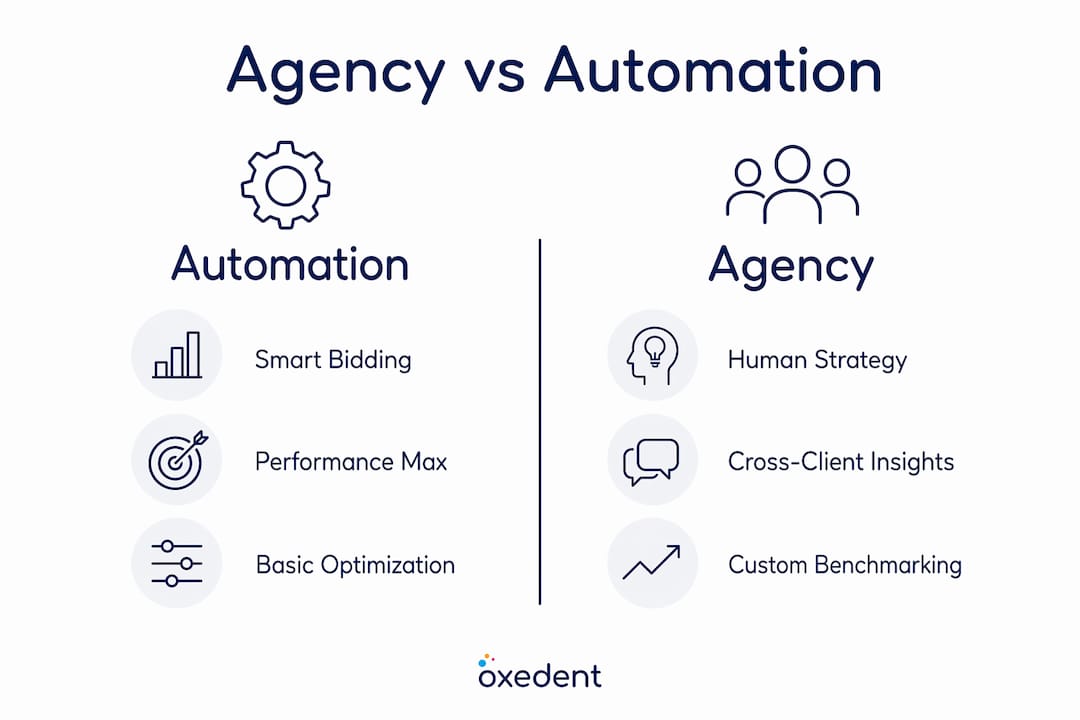

Why google ads agencies beat automation through human strategy
Automation in Google Ads, specifically Smart Bidding and Performance Max, is genuinely impressive. It processes signals at a scale no human can match, adjusting bids in real time across millions of auctions. The problem is that it only optimises for what it can measure on the platform.
Automation optimises for platform-measurable conversions, often ignoring upper-funnel activity and long-term brand lift. That means your campaigns can show strong conversion numbers while quietly starving the awareness that feeds future demand.
A specialist agency adds the strategic layer that automation cannot provide on its own. Human experts set the guardrails: negative keyword lists, brand exclusions, audience signals, and asset group structures that steer the algorithm toward genuinely valuable outcomes. Without those guardrails, Smart Bidding will find the path of least resistance, which is rarely the path of highest profit.


The evidence supports this clearly. A 2026 90-day study found that hybrid manual-automation campaigns achieved 64% more conversions at 32% lower cost per acquisition compared to manual-only campaigns. That is not a marginal improvement. It shows that the winning formula is human strategy guiding automated execution, not one replacing the other.
Here is what agency-managed hybrid campaigns typically include that pure automation skips:
- Negative keyword management to prevent wasted spend on irrelevant queries
- Brand exclusion lists to stop Performance Max cannibalising organic and direct traffic
- Audience signal layering to give Smart Bidding a head start with high-quality data
- Asset group segmentation to maintain creative control and message relevance
- Conversion tracking audits to confirm the algorithm is learning from real revenue signals
Pro Tip: Before activating Smart Bidding on any campaign, have your agency verify that your conversion tracking records actual purchases, not just page visits or micro-events. The algorithm is only as good as the data you feed it.
What are the pitfalls of pure automation in google ads?
Relying solely on automation is one of the most common and costly mistakes ecommerce brands make. The risks are specific, and each one directly erodes your return on ad spend.
“The automation vs human debate is a false dichotomy. Agencies act as strategic architects, providing guardrails that prevent AI from optimising on false metrics like spam leads.” — The Google Ads Tug-of-War
The five most damaging pitfalls of pure automation are:
-
Spam lead optimisation. Performance Max campaigns frequently generate spam leads because the AI optimises for any form completion, not qualified enquiries. Without human oversight to set honeypots and configure offline conversion tracking, budget disappears into worthless submissions.
-
The convergence trap. When all advertisers use identical automation settings, they effectively bid against each other on the same signals. Costs rise, differentiation disappears, and no single brand wins. An agency breaks this cycle through strategic differentiation.
-
Premature automation. Smart Bidding requires 15–30 conversions per month to stabilise and learn effectively. Activating it before that threshold causes volatile CPCs and wasted spend. Agencies manage the manual phase deliberately, building data quality before handing control to the algorithm.
-
Loss of targeting transparency. Performance Max gives advertisers limited visibility into where ads appear and who sees them. Without agency-level auditing, you may be paying for placements that would never convert your customers.
-
Short-term metric distortion. Automation chases the conversions it can attribute. That often means it deprioritises brand campaigns and upper-funnel activity, producing results that look good in a dashboard but weaken long-term revenue.
Each of these pitfalls is preventable. None of them are solved by switching off automation entirely. They are solved by placing an expert agency between your budget and the algorithm.
When does hiring a google ads agency outperform automated tools?
The advantages of hiring an agency become most pronounced at specific points in your ecommerce growth. Knowing those thresholds helps you make the right call at the right time.
Professional agencies become cost-effective above £5,000 monthly ad spend, where campaign complexity grows beyond what a single resource can manage. Below that level, a well-configured automated setup may suffice. Above it, the number of campaigns, product feeds, audience segments, and bidding strategies multiplies quickly.
| Scenario | Automated Tool | Google Ads Agency |
|---|---|---|
| Monthly spend under £3,000 | Sufficient for basic campaigns | Likely over-investment |
| Monthly spend over £5,000 | Misses complexity and waste | Identifies 5–10 concrete issues |
| Multi-channel ecommerce scaling | Limited cross-channel view | Full Performance Max, Shopping, and Search expertise |
| Seasonal peaks (e.g. Black Friday) | Reacts after the fact | Plans and pre-empts with benchmarking |
| Feed quality issues | Cannot diagnose root cause | Audits and fixes feed at source |
Agencies also bring enterprise-level software that most individual advertisers cannot justify purchasing independently. Tools for feed management, competitive intelligence, and cross-account reporting give agency teams a structural advantage over any single automated platform.
Pro Tip: Ask any prospective agency to show you a sample audit report before you sign anything. A strong audit names specific issues, quantifies their cost, and proposes costed fixes. Vague promises about “improving performance” are a red flag.
The impact of agency expertise on ads is most visible during periods of rapid scaling. Automation can increase volume, but it cannot decide whether that volume is profitable. That judgement requires human experience and sector knowledge.
How do agencies use benchmarking to improve ecommerce performance?
One of the most underrated benefits of a Google Ads agency is access to cross-client data. An agency managing 30 ecommerce accounts in your sector sees patterns that your isolated account never could.
Agencies use cross-client benchmarking to identify seasonal CPA trends and sector-specific performance benchmarks invisible to individual advertisers. That means they can tell you whether your cost per acquisition is high for your category, or whether a sudden performance dip is a you problem or an industry-wide shift.
| Metric | Isolated In-House Account | Agency with Cross-Client View |
|---|---|---|
| Seasonal CPA trends | Visible only after the fact | Spotted weeks in advance |
| Sector benchmark CPA | Unknown without external data | Compared across similar accounts |
| Anomaly detection | Noticed when damage is done | Flagged proactively |
| Competitor bidding shifts | Invisible | Inferred from cross-account signals |
This benchmarking advantage is particularly valuable for ecommerce brands approaching peak trading periods. An agency that has managed Black Friday campaigns across multiple retail accounts knows which bid adjustments to make in october, not november. That proactive approach is something no automated tool can replicate from a single account’s history.
Detailed agency reporting translates this cross-client intelligence into clear, account-specific recommendations. You get the benefit of sector-wide insight without needing to manage multiple accounts yourself.
What best practices maximise agency-managed google ads results?
Getting the most from an agency-managed Google Ads account requires active collaboration, not passive delegation. These practices make the difference between good results and great ones.
- Start manual, then automate. Build at least one month of clean conversion data before activating Smart Bidding. This gives the algorithm a strong foundation and reduces early volatility.
- Define conversion goals precisely. Tell your agency exactly what a valuable conversion looks like. Purchase value, not just purchase count, should drive bidding decisions wherever possible.
- Set up offline conversion tracking. For ecommerce brands with high return rates or subscription models, feeding post-purchase data back into Google Ads improves bid quality significantly.
- Schedule regular account audits. A structured audit catches waste, identifies new opportunities, and keeps the account aligned with your current business priorities.
- Agree on reporting cadence and KPIs upfront. Weekly or fortnightly reporting with agreed metrics prevents misaligned expectations and keeps both parties focused on revenue, not vanity metrics.
- Avoid locking into rigid campaign structures. Ecommerce catalogues change. Your agency should adjust campaign and ad group structures as your product range evolves, not maintain a static setup from month one.
The role of PPC in ecommerce growth depends heavily on the quality of the human decisions surrounding the automated systems. Automation handles execution. Your agency handles strategy, quality control, and adaptation.
Key takeaways
A Google Ads agency beats pure automation because human strategic oversight prevents costly algorithmic errors while directing automation toward genuinely profitable outcomes.
| Point | Details |
|---|---|
| Hybrid campaigns outperform | Combining human strategy with automation delivers 64% more conversions at 32% lower CPA. |
| Automation has specific failure modes | Spam leads, convergence traps, and premature activation all require human intervention to prevent. |
| Agency value scales with spend | Above £5,000 monthly spend, agency expertise identifies and fixes issues automated tools miss. |
| Benchmarking is a structural advantage | Cross-client data lets agencies spot seasonal trends and sector CPA benchmarks no single account can see. |
| Collaboration drives results | Clear conversion goals, regular audits, and agreed KPIs maximise the return from agency-managed campaigns. |
Why i think the human touch will always matter in google ads
The automation debate tends to attract two camps: those who think AI will eventually replace agency expertise entirely, and those who dismiss automation as a shortcut for lazy advertisers. Both miss the point.
What I have seen, working across ecommerce accounts at different stages of growth, is that automation fails in predictable ways. It is not random. It optimises aggressively toward whatever signal you give it, and if that signal is slightly wrong, the campaign drifts in entirely the wrong direction. I have watched Performance Max campaigns quietly spend thousands on placements that had nothing to do with the brand’s customers, all while reporting healthy conversion numbers. The conversions were real. The customers were not the right ones.
The 71% of advertisers now using Performance Max creates a new kind of risk. When everyone uses the same tool with the same default settings, the differentiation disappears. The brands that win are the ones with an expert shaping how the algorithm behaves, not just switching it on.
I also think the future is genuinely exciting. AI in Google Ads is getting better, and agencies that embrace it rather than resist it will deliver stronger results. But the strategic layer, the judgement about what a good customer looks like, what a profitable conversion is worth, and when to push volume versus protect margin, that will always need a human being who understands your business.
— Biplab
How Oxedent combines expert oversight with automation for better results
If you are an ecommerce brand spending meaningfully on Google Ads and not seeing the returns you expect, the gap is almost certainly in the strategic layer around your automation.

Oxedent is a specialist ecommerce PPC management agency focused exclusively on online retail brands. The team manages Google Ads, Performance Max, and Google Shopping campaigns with a strict focus on profitability and return on ad spend, not clicks or impressions. Oxedent brings cross-client benchmarking, feed optimisation, and structured audits to every account, ensuring automation works for your business rather than against it. There are no long-term contracts and no vague promises. If you are ready to see what expert-guided automation actually looks like, explore how Oxedent works with ecommerce brands.
FAQ
What is the main difference between a google ads agency and automation?
A Google Ads agency provides strategic human oversight that directs and corrects automated systems, while pure automation operates on platform signals alone. Agencies prevent common failures like spam leads, convergence traps, and premature Smart Bidding activation.
When should an ecommerce brand hire a google ads agency?
Hiring an agency becomes cost-effective above approximately £5,000 in monthly ad spend, where campaign complexity exceeds what automated tools or a single resource can manage effectively.
Does automation replace the need for a google ads agency?
Automation does not replace agency expertise. Hybrid campaigns combining human strategy with Smart Bidding deliver significantly better results than either approach alone, including 64% more conversions at 32% lower cost per acquisition.
What is the convergence trap in google ads?
The convergence trap occurs when multiple advertisers use identical automation settings, causing them to bid against each other on the same signals. An agency differentiates your strategy to avoid this cost-inflating cycle.
How many conversions does smart bidding need to work properly?
Smart Bidding requires 15–30 conversions per month to stabilise. Agencies manage the manual phase before that threshold to build data quality and prevent volatile CPCs.