


PPC management outsourcing is the practice of hiring a specialised external team to plan, execute, and optimise paid advertising campaigns across platforms such as Google Ads, Facebook Ads, and Google Shopping. Agencies outsource PPC management because building an in-house team capable of matching specialist-level performance is 30–50% more expensive than engaging an external partner. For eCommerce marketing professionals, this distinction matters enormously. The gap between a generalist running paid search and a specialist managing Performance Max with feed-first execution is not marginal. It is the difference between profitable scaling and wasted budget.
What core benefits do agencies gain by outsourcing PPC management?
Outsourcing PPC management gives agencies access to certified specialists without the overhead of full-time employment, ongoing training, or tool subscriptions. That combination of expertise and cost efficiency is the primary reason agencies choose this model.
The advantages break down clearly:
- Specialist expertise on demand. External PPC teams hold Google Ads and Meta certifications, stay current with platform changes, and apply knowledge across dozens of accounts simultaneously. You get that depth without recruiting or retaining it internally.
- Significant cost reduction. Eliminating salaries, benefits, and software overhead makes outsourcing materially cheaper than building an equivalent in-house capability. For most agencies, this saving is reinvested directly into client acquisition or service expansion.
- Access to advanced tools. Specialist agencies use proprietary bid management platforms, feed optimisation software, and attribution tools that are expensive to maintain internally. You benefit from enterprise-grade technology without the licence costs.
- Scalability without operational strain. Scaling in-house PPC teams creates attention scarcity and optimisation gaps. Outsourced partners absorb volume increases without the hiring lag or quality dip that internal scaling typically produces.
- Improved campaign performance. Continuous optimisation by dedicated specialists, rather than stretched generalists, produces better ROAS over time. Specialist eCommerce PPC agencies improve client retention precisely because their results are consistent and data-driven.
Pro Tip: When evaluating a PPC outsourcing partner, ask specifically how they separate branded from non-branded campaign performance in reporting. Agencies that cannot answer this clearly are measuring the wrong things.
The operational benefit that often goes unmentioned is attention reallocation. When your internal team stops managing bid adjustments and feed errors, they focus on strategy, client relationships, and business development. That shift alone justifies the model for many agencies.


How does PPC outsourcing benefit eCommerce agencies managing complex feeds?
ECommerce PPC is a different discipline from lead generation paid search. The technical requirements around product feeds, campaign architecture, and attribution make it genuinely difficult to execute well without dedicated expertise.
Here is why outsourcing this work to a specialist matters for eCommerce agencies specifically:
- Product feed optimisation. Google Shopping and Performance Max campaigns live or die on feed quality. Feed health, GTIN coverage, and clean product data directly determine which queries trigger your ads and at what cost. Specialist agencies manage feed hygiene as a core discipline, not an afterthought.
- Branded versus non-branded separation. Measuring true incremental ROAS requires separating branded traffic from non-branded. Without this split, you are crediting brand awareness spend with performance it did not generate. Specialists build this separation into campaign architecture from day one.
- Performance Max execution. Performance Max campaigns require dual execution: technical platform work and strategic integration with the broader acquisition mix. Most in-house teams lack the experience to manage asset groups, audience signals, and budget allocation across this campaign type effectively.
- Conversion tracking integrity. Accurate attribution across Google Ads, GA4, and server-side tracking is a technical requirement that specialist agencies handle as standard. Errors here corrupt every performance metric you rely on.
- Contribution margin focus. Linking ad spend to real business outcomes rather than surface metrics like clicks or impressions requires building campaigns around contribution margin, new customer CAC, and verified conversion data. This is the standard for specialist eCommerce PPC partners.
| Technical requirement | In-house challenge | Outsourced advantage |
|---|---|---|
| Product feed management | Requires dedicated feed tooling and daily monitoring | Specialists use feed platforms as standard practice |
| Branded/non-branded split | Often overlooked in campaign setup | Built into architecture from the outset |
| Performance Max management | Limited experience across asset types | Managed across multiple accounts with proven frameworks |
| Conversion tracking | GA4 and server-side setup requires developer resource | Handled as part of onboarding and ongoing audit |
For eCommerce agencies, the PPC agency specialisation benefits are not abstract. They translate directly into better ROAS, lower wasted spend, and campaigns that scale profitably.
What risks do agencies mitigate by outsourcing PPC?
Outsourcing PPC management does not eliminate risk, but it shifts risk management to teams with the experience and systems to handle it properly.
The specific risks that specialist partners mitigate include:
- Policy violations and account suspensions. Google Ads and Meta enforce advertising policies that change regularly. Experienced agencies implement compliance controls that reduce the likelihood of account suspensions, which can devastate eCommerce revenue overnight.
- Budget mismanagement. Without proper campaign structure and negative keyword management, ad spend leaks into irrelevant queries. Specialist oversight catches these inefficiencies before they compound.
- Accountability gaps. Selecting partners based on CPA, ROAS, and full path attribution rather than click volume ensures you are measuring what actually matters. Agencies that report on impressions and clicks without tying results to revenue are not accountable partners.
- Knowledge loss during transitions. Maintaining some internal capability is important even when outsourcing. Agencies that fully hand over PPC without retaining strategic oversight risk losing institutional knowledge about their clients’ businesses.
“PPC success lies in accountability beyond quick traffic gains, requiring tracking of all conversion paths and revenue metrics.” — USA Today contributor guide, 2026
The practical implication is straightforward. You need a partner who reports on contribution margin and new customer acquisition cost, not one who celebrates a drop in cost per click while revenue stays flat.
Outsourcing versus insourcing PPC: how do you decide?
The decision to outsource or build an in-house PPC team is not binary. Most agencies that perform well operate a hybrid model, combining internal strategic direction with outsourced channel execution.
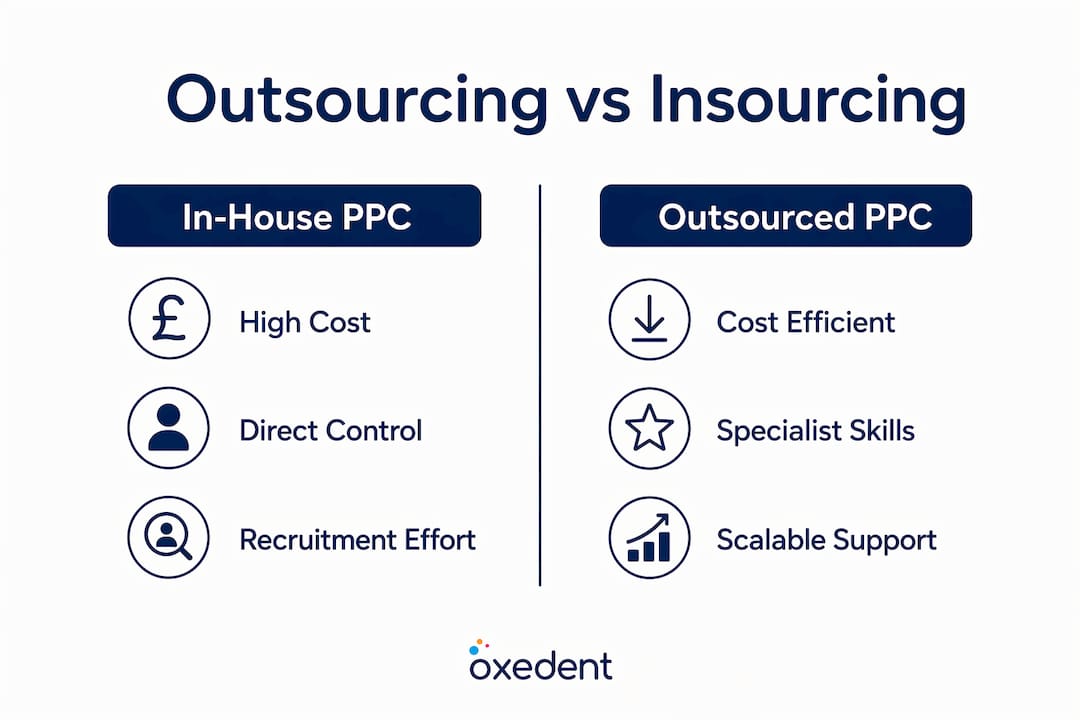

| Factor | In-house PPC team | Outsourced PPC partner |
|---|---|---|
| Upfront cost | High (recruitment, salaries, tools) | Lower (agency fee, no overhead) |
| Expertise depth | Depends on hiring quality | Specialist-level from day one |
| Scalability | Slow, constrained by headcount | Flexible, scales with client volume |
| Strategic control | Full internal control | Requires clear briefing and KPIs |
| Knowledge retention | Builds over time | Risk of loss if partnership ends |
| Speed to performance | Slower ramp-up period | Faster, proven frameworks applied immediately |
The case for insourcing strengthens when PPC is genuinely central to your agency’s positioning and you have the volume to justify a dedicated team. A large agency managing fifty or more eCommerce accounts may reach a point where a specialist in-house team makes financial sense. However, operational strain from scaling in-house is a consistent challenge. Turnover, optimisation gaps during onboarding, and the cost of keeping skills current all erode the apparent cost advantage.
The hybrid model works well in practice. Your internal team owns the client relationship, sets strategy, and defines KPIs. The outsourced partner handles platform execution, feed management, and continuous optimisation. This structure preserves strategic control while accessing specialist depth where it matters most.
Pro Tip: Before outsourcing, document your clients’ campaign goals, attribution models, and reporting requirements in a single brief. Partners who receive a clear brief deliver measurably better results than those working from vague objectives.
For eCommerce agencies specifically, the advantages of outsourced PPC are most pronounced in the technical execution layer. Feed management, Performance Max architecture, and conversion tracking are areas where specialist partners consistently outperform stretched in-house generalists.
Key takeaways
Agencies outsource PPC management because specialist external partners deliver better campaign performance, lower operational costs, and scalable execution than most in-house teams can match, particularly for technically demanding eCommerce campaigns.
| Point | Details |
|---|---|
| Cost efficiency | Outsourcing is 30–50% cheaper than in-house by removing salaries, benefits, and tool costs. |
| Specialist expertise | External partners bring certified, platform-specific skills that take years to build internally. |
| ECommerce technical depth | Feed optimisation, Performance Max, and branded/non-branded splits require dedicated specialist knowledge. |
| Risk mitigation | Experienced agencies manage compliance, budget controls, and attribution to protect account health. |
| Hybrid model advantage | Combining internal strategy with outsourced execution preserves control while accessing specialist performance. |
My honest view on PPC outsourcing for eCommerce agencies
From working closely with eCommerce brands and agencies, the single biggest mistake I see is outsourcing PPC without defining what success looks like first. Agencies hand over campaigns with vague briefs and then measure the wrong outputs. Click volume goes up, ROAS looks acceptable, but new customer acquisition cost is never tracked and contribution margin is never discussed.
The agencies that get the most from outsourcing treat their PPC partner as an extension of their own team. They share product margin data, seasonal priorities, and customer lifetime value benchmarks. That context transforms what a specialist partner can do. Without it, even the best external team is optimising in the dark.
I also think the fear of losing internal capability is overstated when managed correctly. The real risk is not outsourcing itself. It is outsourcing without maintaining strategic oversight. Keep one person internally who understands the channel well enough to ask the right questions, review reports critically, and hold the partner accountable. That combination of internal direction and external execution is where the best results come from.
The future of PPC management will blend AI-driven automation with human strategic judgement. Specialist agencies are already ahead of most in-house teams on this. The gap will widen, not narrow, over the next few years.
— Biplab
How Oxedent supports agencies outsourcing their PPC campaigns
If you are an eCommerce agency looking to deliver better paid media results without building an internal PPC team from scratch, Oxedent is built for exactly this.

Oxedent specialises exclusively in eCommerce PPC management, covering Google Ads, Google Shopping, Performance Max, and Facebook Ads with a strict focus on profitability and ROAS rather than vanity metrics. The team handles feed optimisation, branded versus non-branded campaign separation, and conversion tracking integrity as standard. White-label arrangements are available, so your agency brand stays front and centre with your clients. There are no long-term contracts, and every engagement starts with a clear qualification process to confirm the fit is right. Get in touch with Oxedent to discuss how specialist PPC support can scale your clients’ results.
FAQ
Why do agencies outsource PPC management rather than hire in-house?
Outsourcing PPC management is 30–50% more cost-effective than maintaining an in-house team, and provides immediate access to specialist expertise without recruitment delays or training costs.
Can agencies outsource PPC effectively without losing client trust?
Yes. White-label PPC outsourcing allows agencies to deliver specialist-level campaign management under their own brand, maintaining client relationships while accessing external expertise.
What should agencies look for when choosing a PPC outsourcing partner?
Prioritise partners who report on CPA, ROAS, and full attribution rather than click volume, and who demonstrate specific experience with eCommerce feed management and Performance Max campaigns.
What is the biggest risk of outsourcing PPC management?
Knowledge loss over extended periods is the primary risk. Agencies should retain internal strategic oversight and maintain clear KPIs to avoid over-dependence on external partners.
How does eCommerce PPC outsourcing differ from standard PPC outsourcing?
ECommerce PPC requires product feed optimisation, GTIN coverage, and branded versus non-branded campaign separation, all of which demand specialist knowledge that goes well beyond standard paid search management.