


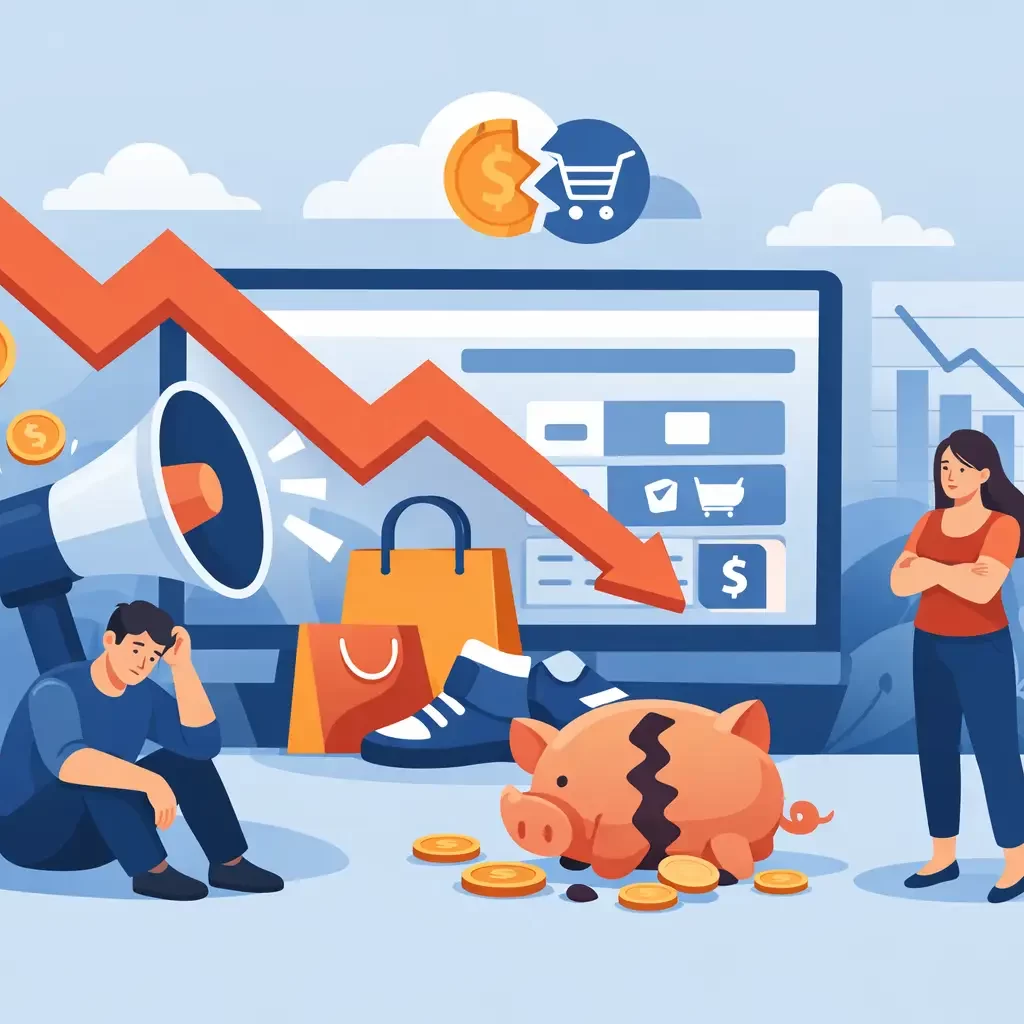
If you are asking why ecommerce ads are not profitable, the problem is rarely the ad platform on its own. More often, it is a commercial issue hiding inside the account – weak margins, bad tracking, poor product economics, low conversion rates, or scaling decisions made far too early. Ads simply expose what the business model and website cannot support.
That is the uncomfortable part. Paid media is brutally honest. It does not care how good the brand story sounds, how much time went into the creative, or whether the campaign generated a healthy number of clicks. If the numbers underneath the traffic do not work, the account will not be profitable for long.
Why ecommerce ads are not profitable in the first place
A lot of brands treat ad performance as if it lives entirely inside Google Ads or Meta Ads. It does not. Profit sits at the intersection of traffic quality, conversion rate, average order value, repeat purchase rate, gross margin and tracking accuracy. Miss on one or two of those, and the whole thing gets distorted.
This is why some businesses spend months blaming Performance Max, Facebook targeting, or rising CPCs when the real issue is that they are trying to buy customers at a cost their economics cannot tolerate. If your product margin is thin, your shipping is expensive, and your returns rate is high, you are running uphill before the campaign even starts.
There is also a timing problem. Many ecommerce brands expect paid media to produce profit immediately at scale. That can happen, but it is not automatic. New customer acquisition often looks weaker on first purchase than it does over a 60 or 90-day period. If you do not know your customer lifetime value and only judge campaigns on front-end revenue, you can cut channels that are actually commercially useful. On the other hand, hiding behind lifetime value to excuse obviously poor acquisition is just as dangerous. The answer is discipline, not wishful thinking.
The margin problem nobody wants to face
The fastest way to make paid ads look broken is to ignore breakeven cost of sale. Established ecommerce brands should know, with precision, what they can afford to pay for a sale by product category, not just at account level.
If one range carries a 70 per cent margin and another carries 25 per cent, they should not be pushed with the same budget logic. Yet many accounts do exactly that. Bestsellers get more spend, but not necessarily because they are the most profitable. Sometimes they simply get the most clicks.
This is where profitable accounts are built differently. Budget allocation should follow contribution, not vanity. A product can have a strong return on ad spend and still be commercially weak once discounts, shipping, refunds and payment fees are factored in. A channel report that stops at platform ROAS is not a profit report.
Strong revenue can still mean weak profit
A common pattern looks like this: revenue rises, the blended ROAS looks acceptable, and everyone feels positive. Then stock pressure increases, fulfilment costs rise, and cash gets tighter rather than looser. That is not growth. That is expensive turnover.
If your ads are generating sales but not profit, the account may not be underperforming in the usual sense. It may simply be scaling the wrong products, the wrong audiences or the wrong offer.
Bad tracking leads to bad decisions
You cannot optimise what you cannot trust. If attribution is inflated, duplicated or incomplete, you end up making confident decisions on weak data.
This is one of the biggest reasons why ecommerce ads are not profitable. Brands think they are buying efficient sales because the platform says so, while in reality the account is taking credit for conversions that would have happened anyway. Branded search, remarketing and demand capture campaigns are especially vulnerable to this.
The opposite also happens. Under-tracking can make good campaigns look unprofitable, causing brands to cut spend before the system has enough data to optimise properly. Neither scenario is a media buying issue first. It is a measurement issue.
A serious ecommerce setup needs clean conversion tracking, proper feed data, sensible attribution expectations and reporting that connects ad spend to actual commercial outcomes. Without that, optimisation becomes guesswork dressed up as strategy.
Your website may be the bottleneck, not the ads
Plenty of accounts have respectable traffic quality and still lose money because the site does not convert well enough. If product pages are thin, trust signals are weak, delivery information is vague, and mobile usability is poor, paid traffic becomes very expensive very quickly.
Ad platforms can send visitors. They cannot fix hesitation once people arrive.
This matters even more in competitive categories where your click costs are already high. When the market is expensive, the website has to do more of the heavy lifting. A small gain in conversion rate or average order value can change the economics of an account far more than another round of audience tweaks.
Low intent traffic is not always the villain
There is a tendency to blame broad targeting or upper-funnel campaigns whenever profitability slips. Sometimes that is fair. Sometimes it is lazy diagnosis.
Broader traffic can work extremely well if the offer is sharp, the site is credible, and the product-market fit is proven. But if the landing experience is weak, all broad traffic does is expose the weakness faster. The issue is not just who you are targeting. It is what happens after the click.
The account structure is often too loose
Generalist campaign management is one reason many ecommerce accounts plateau. Products with different margins, demand patterns and purchase journeys get lumped together in campaign structures that make sensible optimisation impossible.
When campaign architecture is too broad, budget leaks into low-value search terms, weak placements, poor geographies and products that should never have been scaled. The platform will spend your money somewhere. That does not mean it is spending it well.
Profitable ecommerce PPC usually requires tighter control than brands expect. Feed segmentation matters. Search query control matters. Exclusion strategy matters. Audience layering matters. Creative testing matters. The details are not admin. They are where profit is won or lost.
This is especially true with Google Shopping and Performance Max. Both can be powerful. Both can also hide waste if the product feed is poor or the account is left to run on defaults. Automation is useful when it is guided. It is expensive when it is trusted blindly.
Scaling too early destroys efficiency
A campaign that works at £100 a day does not automatically work at £1,000 a day. As spend rises, efficiency usually changes. Impression share expands, audience quality broadens, and the account starts paying for users who were less likely to convert in the first place.
That does not mean scaling is impossible. It means scaling needs to be deliberate. If a brand pushes budget up before creative, landing pages, stock depth and feed quality are ready, profitability tends to collapse. Then the platform gets blamed for doing exactly what it was told to do – spend more.
A lot of wasted budget comes from impatience disguised as ambition. Serious growth is not random budget inflation. It is controlled expansion with clear guardrails around cost of sale, customer quality and cash flow.
Offers, pricing and market reality still matter
Sometimes the ads are competent and the economics still do not work because the market has moved. Competitors discount harder. Delivery expectations rise. Consumer demand softens. Your product is no longer differentiated enough to justify the acquisition cost.
Paid media cannot rescue a weak offer. It can amplify a strong one, but it cannot manufacture demand where there is no competitive reason to buy.
This is why profitable brands review messaging and offer strategy alongside account performance. If click-through rate is low, conversion rate is weak and returning customer rate is falling, the issue may be wider than campaign setup. The market may be telling you something you do not want to hear.
What profitable ecommerce advertising actually requires
Profitable accounts are rarely built on one breakthrough tactic. They are built on commercial alignment. The business knows its margins. Tracking is reliable. The product feed is clean. Campaign structure reflects product economics. The website converts. Creative is tested properly. Scaling happens only when the numbers justify it.
That is not glamorous, but it is where the wins are.
For established retailers, the real question is not whether paid media can work. It is whether the account is being managed with enough commercial discipline to make it work. That is a different standard entirely, and it is the reason specialist ecommerce PPC firms such as Oxedent exist in the first place.
If your ads are spending, reporting revenue and still not producing enough profit, stop looking for a platform trick. Start with the economics, the data and the structure. Once those are right, paid media becomes far easier to scale without funding your own inefficiency.