


Google Ads retargeting is the practice of showing targeted ads to people who have already visited your ecommerce store, with the goal of bringing them back to complete a purchase. Most online retailers focus heavily on acquiring new traffic, yet 96–98% of first-time visitors leave without buying. That is the core problem retargeting solves. Understanding why ecommerce needs Google Ads retargeting means understanding that your paid traffic budget is only half the equation. The other half is what you do with the visitors you have already paid to attract.
Why ecommerce needs google ads retargeting to recover lost visitors
The numbers behind visitor loss are stark. Ecommerce stores lose 96–98% of visitors on their first visit, and cart abandonment rates sit at close to 70% across the industry. That means the overwhelming majority of people who land on your product pages, browse your catalogue, and even add items to their basket will leave without converting. Without a recovery mechanism, that traffic spend is largely wasted.
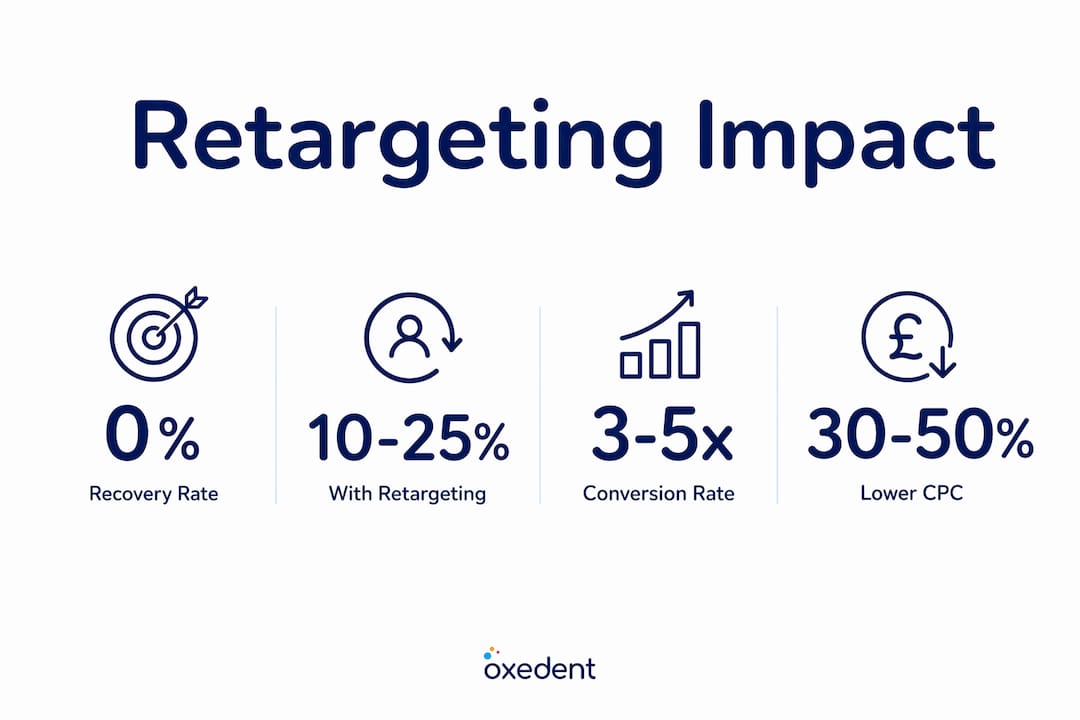
Retargeting is that recovery mechanism. By placing a Google Ads tag on your site and building audience lists through Google Ads or Google Analytics 4, you can serve ads specifically to those previous visitors across the Google Display Network, YouTube, and Search. Retargeting converts lost visitors at 3–5 times the rate of cold traffic. That uplift exists because the audience already knows your brand and has demonstrated intent.


Dynamic retargeting takes this further. Rather than showing a generic brand ad, dynamic remarketing with product feeds through Google Merchant Center displays the exact products a visitor viewed. Dynamic product ads generate click-through rates 3–6 times higher than generic messaging. The specificity of the creative is what drives that performance gap.
| Metric | Without Retargeting | With Retargeting |
|---|---|---|
| Visitor recovery rate | 0% | 10–25% |
| Conversion rate vs cold traffic | Baseline | 3–5x higher |
| Dynamic ad CTR vs generic | Baseline | 3–6x higher |
| Cart abandonment recovered | None | Significant portion |

Pro Tip: Set up your Google Ads tag and link your GA4 property before you launch any retargeting campaign. Without this, your audience lists will be empty and your campaigns will have no one to target.
What are the key benefits of google ads retargeting for ecommerce?
The benefits of Google Ads retargeting go well beyond simply reminding people your store exists. The financial case is compelling on its own. Retargeting audiences convert at 2–3 times the rate of cold traffic, with cost-per-click running 30–50% lower. Lower cost combined with higher conversion rate produces a significantly improved return on ad spend. That is why retargeting consistently delivers some of the strongest ROAS figures in any ecommerce paid media account. For a deeper look at how this fits into your wider paid strategy, the role of Google Ads in ecommerce revenue is worth understanding in full.
The strategic advantages extend across several dimensions:
- Lower cost per acquisition. Retargeting audiences are warmer and cheaper to convert, reducing your overall customer acquisition cost.
- Personalised ad delivery. Dynamic ads pull directly from your product feed, showing each visitor the items they actually browsed rather than a generic message.
- Audience segmentation. You can separate cart abandoners, product viewers, past purchasers, and lapsed customers into distinct lists and tailor messaging to each group.
- Multi-platform reach. Google’s network spans the Display Network, YouTube, Gmail, and Search, giving you multiple touchpoints with the same high-intent audience.
- Budget efficiency. Retargeting campaigns typically account for 15–25% of total ad budgets and complement prospecting campaigns rather than competing with them.
Pro Tip: Apply frequency capping to your Display retargeting campaigns. Showing the same ad to the same person more than 5–7 times per week creates ad fatigue and can actively damage brand perception.
How does first-party data improve google ads retargeting?
First-party data is the foundation of effective retargeting campaigns in Google Ads. Google refers to these as “Your Data” segments, which include Customer Match lists, website visitor audiences, and app user lists. These segments feed directly into Google’s Smart Bidding algorithms, including Target ROAS. Google’s automated bidding relies heavily on first-party data segments that must be well maintained to function at their best.
The impact reaches beyond dedicated retargeting campaigns. Embedding first-party data audience lists in Google Ads improves Smart Bidding performance even in prospecting campaigns where you are not directly targeting those audiences. Google’s AI uses the behavioural signals from your known audiences to identify similar high-intent users in broader campaigns. Clean, well-structured data makes the algorithm smarter across your entire account.
Customer Match is particularly powerful for ecommerce. By uploading your email subscriber list or past purchaser data, you can suppress existing customers from acquisition campaigns, bid more aggressively for lapsed buyers, and create lookalike-style signals for new customer prospecting. The quality of your data determines the quality of your results.
| Retargeting Tactic | Without First-Party Data | With First-Party Data |
|---|---|---|
| Smart Bidding accuracy | Limited signals | Higher-intent targeting |
| Customer Match | Not available | Suppress, re-engage, upsell |
| Audience segmentation | Broad behavioural only | Behavioural plus CRM data |
| Prospecting campaign AI | Generic signals | Enriched lookalike signals |
One critical warning: over-segmentation of retargeting lists without sufficient data volume harms Google’s AI optimisation. If your audience segments are too small, the bidding algorithm cannot gather enough conversion data to optimise effectively. Keep segments large enough to generate meaningful signal.
Pro Tip: Consolidate small audience segments into broader groups until each list contains at least 1,000 active users. Google’s Smart Bidding needs volume to learn.
What ecommerce retargeting strategies actually boost sales?
Effective ecommerce retargeting strategies are built around one principle: match the message to the moment. A visitor who viewed a product page needs a different ad than someone who abandoned their basket, and both need something different from a customer who purchased three months ago. Here is how to structure campaigns that convert.
-
Segment by funnel stage. Create separate audience lists for product viewers, cart abandoners, checkout abandoners, and past purchasers. Each group has a different level of intent and requires a different message and bid strategy.
-
Use sequenced messaging. A sequenced consideration arc over multiple days improves conversion rates significantly. Start with a reminder ad on day one, move to a social proof or review-led ad on day three, and introduce an incentive such as free delivery or a discount on day seven if the visitor still has not converted.
-
Deploy dynamic remarketing. Connect your Google Merchant Center product feed to your retargeting campaigns. This allows Google to automatically generate ads featuring the exact products each visitor viewed, which consistently outperforms static creative. You can find a practical walkthrough in Oxedent’s Google Ads campaign types guide.
-
Combine RLSA with Shopping campaigns. Remarketing Lists for Search Ads (RLSA) let you adjust bids on Search and Shopping campaigns for users already on your retargeting lists. A cart abandoner searching for your product category deserves a significantly higher bid than a cold user doing the same search.
-
Exclude converters promptly. Add recent purchasers to an exclusion list across all retargeting campaigns. Showing a purchase ad to someone who bought yesterday wastes budget and irritates customers. Update exclusion lists at least weekly.
-
Test Customer Match for re-engagement. Upload your lapsed customer list (those who have not purchased in 90 or 180 days) and run a dedicated re-engagement campaign with a compelling offer. The cost to re-activate a past buyer is almost always lower than acquiring a new one.
Pro Tip: For remarketing best practices that complement your Google Ads efforts, pairing your retargeting strategy with email remarketing via Klaviyo creates a multi-channel recovery loop that significantly increases your chances of winning back abandoners.
Key takeaways
Google Ads retargeting is the single most cost-efficient tool ecommerce brands have to recover lost visitors, lower acquisition costs, and grow return on ad spend at scale.
| Point | Details |
|---|---|
| Visitor recovery is critical | Up to 98% of first-time visitors leave without buying; retargeting recovers 10–25% of them. |
| Dynamic ads outperform generic | Product feed-driven ads generate CTRs 3–6x higher than standard display creative. |
| First-party data multiplies results | Clean audience lists improve Smart Bidding across your entire account, not just retargeting campaigns. |
| Segment by intent, not just behaviour | Separate cart abandoners, product viewers, and past purchasers to deliver the right message at the right time. |
| Budget allocation matters | Retargeting typically runs at 15–25% of total ad spend and delivers disproportionate returns when managed well. |
Retargeting is not optional: a view from the trenches
By Biplab
After working with ecommerce brands across a wide range of categories, one pattern stands out clearly. The brands that treat retargeting as an afterthought consistently leave money on the table. They pour budget into prospecting, drive traffic to their store, and then do nothing to recover the 97% who leave. It is the equivalent of filling a leaking bucket and wondering why it never gets full.
The most common mistake I see is poor segmentation. Brands lump all website visitors into a single retargeting list and serve them the same generic ad for weeks. That approach ignores the fundamental difference between someone who spent 30 seconds on your homepage and someone who added three items to their basket and got to the payment page. Those two people need completely different conversations.
The second mistake is neglecting first-party data. Many ecommerce businesses have thousands of past customer email addresses sitting in their CRM and never upload them to Google Ads. That data is genuinely valuable. It improves Smart Bidding across your whole account, not just in retargeting. If you are not using Customer Match, you are leaving a meaningful performance advantage unused.
My honest view is that retargeting should receive serious budget and creative attention. The improvement in ROAS from retargeting is not marginal. For most ecommerce accounts, it is one of the highest-returning activities in the entire paid media mix. Treat it as a strategic pillar, not a set-and-forget campaign.
— Biplab
Ready to build a retargeting strategy that actually converts?
Understanding the theory is one thing. Building and managing retargeting campaigns that consistently recover lost visitors and grow your ROAS is another challenge entirely. Oxedent specialises exclusively in ecommerce PPC, which means every campaign structure, audience strategy, and bid optimisation decision is made with retail performance in mind.

Whether you need a full account audit, a retargeting campaign build from scratch, or ongoing management of your Google Ads activity, Oxedent’s ecommerce PPC management service is built for established brands ready to scale profitably. No long-term contracts. No vanity metrics. Just a clear focus on return on ad spend and revenue growth. Get in touch with Oxedent to discuss what a properly structured retargeting strategy could do for your store.
FAQ
What is google ads retargeting for ecommerce?
Google Ads retargeting is the practice of showing paid ads to people who have previously visited your ecommerce store. It uses the Google Ads tag and audience lists to re-engage visitors across the Display Network, YouTube, and Search.
How much does retargeting improve conversion rates?
Retargeting audiences convert at 3–5 times the rate of cold traffic, with cost-per-click running 30–50% lower. That combination produces significantly stronger return on ad spend compared to prospecting campaigns alone.
What is dynamic remarketing and why does it matter?
Dynamic remarketing automatically generates ads featuring the specific products a visitor viewed, using your Google Merchant Center product feed. These ads produce click-through rates 3–6 times higher than generic retargeting creative.
How much of my budget should go to retargeting?
Retargeting campaigns typically account for 15–25% of total ad budgets. This allocation complements prospecting spend and delivers disproportionate returns because the audience is already warm.
Does first-party data only help retargeting campaigns?
No. First-party data audience lists improve Smart Bidding across your entire Google Ads account, including prospecting and Shopping campaigns, by giving Google’s AI richer signals about your highest-value customers.