


Buying more ads is not the same as growing more profitably. Many established eCommerce brands pour significant budget into paid media, only to find their return on ad spend plateauing, their cost per acquisition creeping upward, and their campaigns producing clicks without meaningful revenue impact. The problem is rarely the ad platform itself. It is the absence of strategic integration, technical precision, and a profit-first mindset. This article explains why specialist eCommerce agencies consistently outperform generic media buyers, what technical foundations actually drive results, and how you can determine the right approach for your brand’s next stage of growth.
Table of Contents
- How a specialist agency changes the game for eCommerce brands
- Technical expertise: Why setup and data readiness make or break campaigns
- When in-house or hybrid approaches might beat agency outsourcing
- Key operational levers: What to demand from a specialist agency
- Why the common approach to eCommerce media buying holds brands back
- Partnering with a specialist agency for high-performance growth
- Frequently asked questions
Key Takeaways
| Point | Details |
|---|---|
| Integrated approach wins | Specialist agencies boost growth by connecting paid media with creative and customer retention efforts. |
| Data readiness is critical | Robust tracking and feed setup are essential for campaign effectiveness and measurement accuracy. |
| Context determines value | In-house and hybrid strategies can outperform agencies for some brands with strong internal expertise. |
| Demand operational excellence | Expect agencies to deliver rapid creative testing, profit-driven optimisation, and transparent reporting. |
How a specialist agency changes the game for eCommerce brands
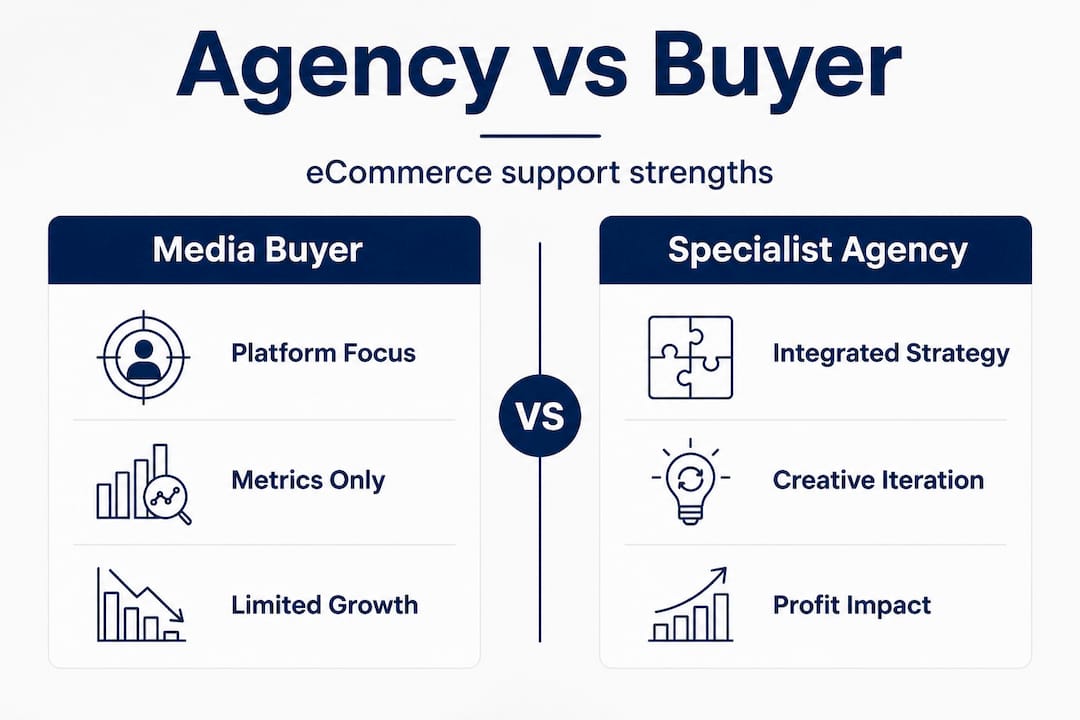
When most people picture a media buyer, they imagine someone managing bids, adjusting audiences, and reporting on click-through rates. That is a narrow and increasingly outdated model. Specialist eCommerce agencies operate across a far wider remit. They connect paid campaign execution to the full profit picture, including creative strategy, landing page conversion rate, customer lifetime value, and product margin. This integration is where the real performance gains live.
Specialist eCommerce paid-media agencies are positioned to connect platform execution with the full economics system, covering creative, landing pages and CRO, and retention and LTV, rather than operating as isolated media buyers. This distinction matters enormously. A generic agency might deliver a strong click-through rate while your actual conversion rate stagnates. A specialist agency asks why the traffic is not converting and fixes the root cause.

Here is a clear comparison to illustrate the gap:
| Area | Typical media buyer | Specialist eCommerce agency |
|---|---|---|
| Primary focus | Ad platform performance | Profitability and revenue growth |
| Creative input | Minimal or reactive | Iterative creative testing strategy |
| Landing page involvement | None | Active CRO collaboration |
| Data and tracking | Basic pixel setup | Full attribution and feed management |
| Campaign structure | Template-based | Rebuilt to match inventory and intent |
| Reporting focus | Clicks, impressions, CTR | ROAS, profit margin, LTV, revenue |
| Scaling approach | Increase budget when results look good | Profit-aware scaling rules and thresholds |
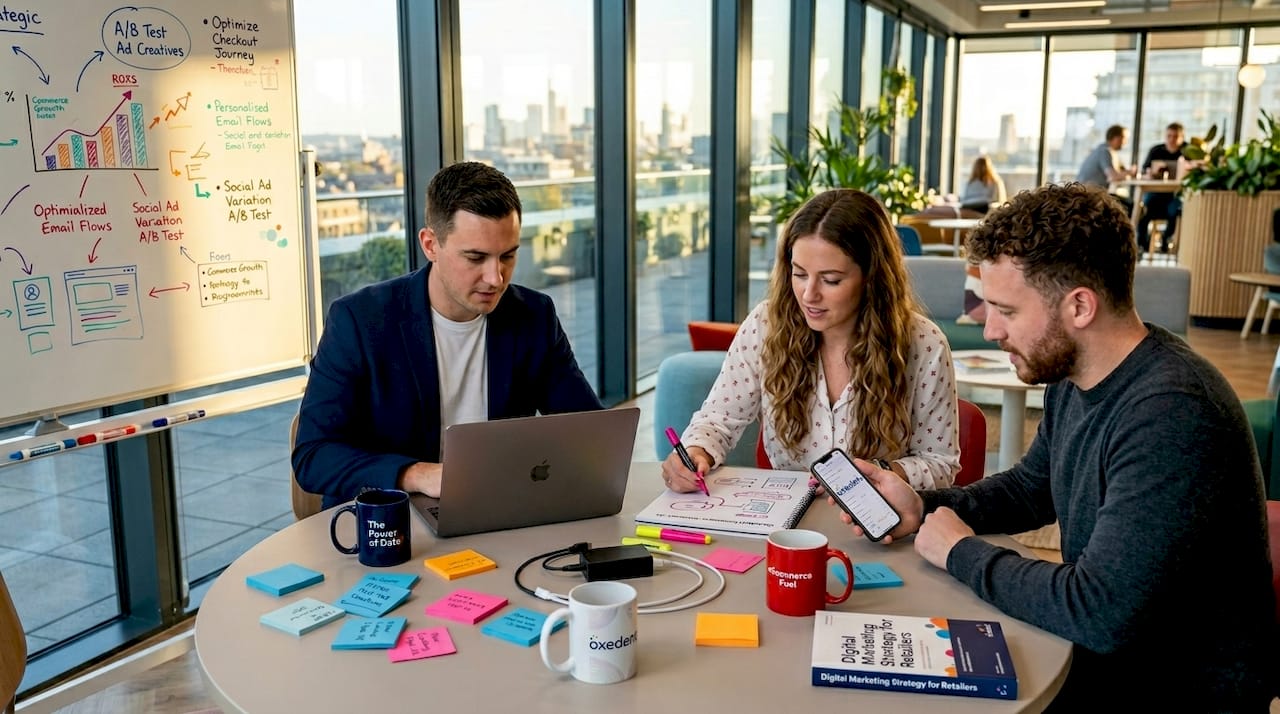
The operational practices that set specialist agencies apart include rebuilding campaign structure from the ground up to reflect your actual product catalogue and customer buying intent, applying blended ROAS strategies rather than optimising each channel in isolation, and iterating creative and landing page experience rapidly to prevent performance decay. These are not extras. They are the core mechanics of a properly run eCommerce paid media programme.

Brands that benefit most from specialist eCommerce agency partnerships are typically those with established revenue, meaningful ad budgets, and a genuine desire to scale sustainably. If you are at that stage, the difference between a generalist and a specialist agency is not marginal. It is often the difference between wasted spend and compounding growth.
One further area worth noting is how paid media integrates with organic visibility. SEO and eCommerce work together to build brand authority and reduce overall customer acquisition costs, which means a specialist agency that understands the interplay between paid and organic channels delivers far more strategic value than one focused purely on ad platforms.
Pro Tip: Ask any prospective agency how they approach creative iteration. If the answer is vague or limited to “testing a few ad variants,” that is a warning sign. True specialists treat creative as a continuous performance lever, not an afterthought.
Technical expertise: Why setup and data readiness make or break campaigns
Here is something many brand owners do not realise until it is too late: your campaign performance is only as good as the data feeding into it. Poor product feeds, broken conversion tracking, and misconfigured attribution do not just limit optimisation; they actively mislead your campaigns and cause your budget to be wasted on the wrong audiences, products, and placements.
Platform algorithms and campaign measurement are directly coupled to data quality, which is why specialist agencies emphasise technical and data readiness, covering feeds, tracking architecture, and conversion measurement, to avoid wasting spend. This is a core reason why specialists outperform generalists: they treat technical foundations as a prerequisite, not an afterthought.
Consider the impact of data quality on key campaign metrics:
| Data issue | Typical impact | Consequence for spend |
|---|---|---|
| Incomplete product feed | Low product eligibility in Shopping | Missed revenue opportunities |
| Broken conversion tracking | Algorithm optimises for wrong signals | Budget spent on non-converting traffic |
| Inaccurate attribution | Misleading ROAS reporting | Incorrect scaling decisions |
| Missing audience signals | Reduced smart bidding accuracy | Higher cost per acquisition |
| Poor URL mapping | Ads sending to wrong landing pages | Reduced conversion rate |
Fixing these issues is not glamorous work, but it is where significant performance gains are often found. Specialist agencies invest proper time in audit and remediation before scaling spend, because they know that accelerating a technically broken campaign simply amplifies waste.
Here are the core steps for a technically sound paid media campaign launch:
-
Conduct a full tracking audit. Verify that all conversion events, including purchases, add-to-cart actions, and checkout initiations, are firing correctly and without duplication. Ensure conversion tracking is set up to reflect actual business outcomes, not proxy metrics.
-
Audit and optimise your product feed. Check titles, descriptions, images, prices, and availability for accuracy and completeness. A well-optimised feed directly improves Shopping campaign eligibility and performance.
-
Establish a clear attribution framework. Decide how you will measure cross-channel contribution. Data-driven attribution is typically more reliable for established brands with sufficient conversion volume.
-
Review campaign structure against inventory logic. Campaigns should reflect how customers browse and buy, not just how products are catalogued internally. Review campaign set-up best practices before launch.
-
Validate audience segments and remarketing lists. Ensure audience data is being collected correctly and that list sizes are sufficient to power smart bidding strategies.
-
Set up profit-aware performance thresholds. Define the ROAS or cost-per-acquisition targets that reflect your actual margins, so that scaling decisions are grounded in profitability rather than surface-level revenue figures.
Beyond paid media, technical SEO for eCommerce plays a parallel role in ensuring your site is structured for both discoverability and conversion, reinforcing the returns from your paid campaigns.
Pro Tip: Never assume your tracking is accurate because it worked at setup. Pixel and tag configurations break during site updates, platform migrations, and theme changes. Build a monthly tracking health check into your agency’s operating rhythm.
When in-house or hybrid approaches might beat agency outsourcing
Specialist agencies offer genuine advantages, but they are not the right fit for every business context. Being honest about this is important. Some brands are better positioned to run paid media in-house or through a hybrid model, and understanding the conditions that make each approach work allows you to make a truly informed decision.
Specialisation is not universally better: there are incentive, accountability, and knowledge transfer edge cases where in-house teams can outperform even a specialist agency. The key word there is “can.” It depends heavily on the calibre of internal talent, the depth of internal data access, and the strategic bandwidth of the team.
Situations where in-house paid media may outperform agency outsourcing:
- Single-channel dominance. If your entire business is built around one platform, and you have a genuinely senior specialist internally, the depth of institutional knowledge can be hard for an external team to match.
- Advanced internal expertise. Brands with experienced in-house PPC specialists who understand margin economics, feed management, and attribution can achieve excellent results without an agency layer.
- Strong internal CRO and creative capabilities. Agencies shine when they can drive the full funnel. If you already have robust internal conversion optimisation and creative production, the agency’s most powerful tools are already in your hands.
- Data sensitivity and integration depth. If your paid media decisions depend on highly proprietary data, such as complex pricing models or real-time inventory signals, an in-house team with direct system access may simply be faster to respond.
“Before outsourcing, ask whether an agency can genuinely access the right internal data to make profit-aware decisions. If the answer involves significant friction, consider whether a hybrid model better serves your growth goals.” This is one of the most important questions brands overlook when evaluating agency partnerships.
For larger brands, a hybrid marketing model is often the most practical reality. An in-house team handles channel strategy, budget allocation, and internal reporting, while a specialist agency manages specific campaign execution, feed optimisation, and creative testing. This structure captures the benefits of deep specialism without fully ceding strategic control.
The in-house versus agency decision is not binary. It is a spectrum, and the optimal position depends on your team’s capabilities, your channel mix, and how rapidly you need to scale. An omnichannel strategy that integrates paid, organic, and retention channels often requires coordinated expertise that a hybrid or specialist model is best placed to deliver.
Key operational levers: What to demand from a specialist agency
Once you have decided to work with a specialist agency, you need to hold them to the right standards. Many brands accept monthly reporting on clicks and impressions and mistake activity for progress. The best specialist agencies operate very differently. You should know what to expect and demand it from day one.
The operational mechanics of a high-performing specialist agency include rebuilding account and campaign structure to match eCommerce inventory and buying intent, setting profit-aware scaling rules, and iterating creative and landing experience quickly to prevent performance decay. These are concrete deliverables, not abstract promises.
Here is what to ask for and expect during onboarding and ongoing management:
-
Full account audit before any spend changes. A specialist agency should audit your existing campaigns, tracking, feed quality, and attribution before adjusting budgets or structures. If they want to start scaling immediately without an audit, be cautious.
-
A clear profit-first performance framework. Ask how they define success. If the answer centres on ROAS alone without reference to margin, contribution, or LTV, push for more. True specialists work with your actual economics.
-
Regular creative iteration with clear hypotheses. Every creative test should have a clear objective and a measurable outcome. Insist on a creative testing calendar that is tied to performance data, not just aesthetics.
-
Transparent feed management reporting. Your product feed directly affects Shopping and Performance Max campaign performance. Ask for regular feed health reports that show eligibility rates, disapprovals, and optimisation actions taken.
-
Access to raw data and attribution models. You should never be dependent on an agency’s proprietary dashboard as your only view of performance. Insist on access to your own Google Ads, Meta Ads, and Analytics data at all times.
-
Proactive shopping campaign optimisation. This means regular bid strategy reviews, audience segmentation updates, and product-level performance analysis rather than set-and-forget management.
The checklist items that separate genuine growth partners from media buyers are straightforward: they ask about your margins, they want to understand your product economics, they involve themselves in landing page performance, and they flag problems before you notice them in your own reporting.
Pro Tip: Insist that your agency shows you underperforming campaigns as transparently as winning ones. If every reporting session only highlights good news, you are not getting the full picture, and waste is likely accumulating in the background.
Why the common approach to eCommerce media buying holds brands back
Here is something we observe repeatedly: established eCommerce brands invest significantly in paid media budgets, but significantly underfund the technical execution, creative strategy, and cross-channel integration that actually determine whether those budgets produce profit. The dashboard looks active. The spend is real. But the returns are mediocre because the foundations are wrong.
There is a comfort in media buying dashboards. They show movement. Impressions, clicks, and even ROAS can look healthy while your effective profit margin is eroding. The metrics that really matter, including new customer acquisition cost against LTV, margin-adjusted ROAS, and creative contribution to conversion, often stay invisible unless you specifically demand them.
We believe the uncomfortable truth in this industry is that many brands use an agency primarily to operate a media-buying function, when they should be demanding a cross-channel, commercially integrated growth partner. In-house capabilities and strong measurement can outperform outsourcing when brands have the internal senior expertise and data infrastructure to do so effectively. But for most scaled brands without that internal depth, genuine specialist agency expertise is the fastest route to sustainable, profit-first growth.
Ask your agency uncomfortable questions. Where is our spend producing the weakest profit? What creative has genuinely moved our conversion rate in the last 90 days? How would our performance look if we stripped out brand search? These questions reveal whether you have a media buyer or a true growth partner. The distinction is worth millions at scale.
Partnering with a specialist agency for high-performance growth
If this article has highlighted gaps in your current paid media approach, the most productive next step is to explore what a specialist eCommerce agency can do for your specific situation. Not every agency is the right fit, and the best ones are selective about the brands they work with.

At Oxedent, our entire focus is eCommerce paid media. We do not offer paid media as one service among many. It is all we do. That focus means our team brings genuine depth to Google Ads, Facebook Ads, Google Shopping, and Performance Max campaigns, with an unwavering emphasis on profitability over vanity metrics. Browse our guide to top specialist PPC agencies to understand what genuine specialism looks like, or visit Oxedent directly to find out whether your brand qualifies for our paid media management service. The right specialist partner can transform how your ad budget performs.
Frequently asked questions
What does a specialist eCommerce agency do differently from generalist agencies?
Specialist agencies connect paid media management with creative strategy, conversion optimisation, and retention for full-funnel profitability, rather than managing ad platforms in isolation. The result is campaign decisions driven by business economics, not just platform metrics.
How does data quality affect eCommerce paid media performance?
Platform algorithms and measurement are directly coupled to data quality, so poor feeds and tracking lead to misguided optimisation and wasted spend. Fixing data foundations is one of the highest-impact actions a specialist agency can take early in an engagement.
Should every eCommerce business outsource to a specialist agency?
Not always. Specialisation is not universally better, and brands with a single dominant channel, advanced internal PPC expertise, and strong measurement infrastructure can perform well in-house or through a hybrid model. The right answer depends on your team’s genuine capabilities and your growth ambitions.
What results can I expect from switching to a specialist agency?
You should see more efficient ad spend, stronger campaign ROI, and faster creative and landing page iteration geared to profit. Rebuilding campaign structure to match buying intent and applying profit-aware scaling rules are among the earliest and most meaningful performance shifts you will notice.