


Google Ads is defined as a pay-per-click advertising platform where automation handles bidding, ad testing, and audience targeting, but only performs as well as the data and configuration it receives. With 8.5 billion searches processed daily and an average cost per click of $2.69, every misconfigured campaign burns real money at scale. The platform’s AI does not distinguish between a profitable sale and a worthless click unless an expert teaches it to. This is why Google Ads needs expert management: the technology amplifies whatever signal it is given, and only a skilled operator ensures that signal points toward profit.
Why Google Ads needs expert management more than ever in 2026
Google Ads management has fundamentally changed. The role is no longer about manually adjusting bids or writing ad copy in isolation. Expert management now means configuring data signals, structuring campaigns to feed automation correctly, and interpreting results that the platform increasingly obscures.


Google’s automated tools, including Smart Bidding, Performance Max, and responsive search ads, handle the tactical layer. They test combinations, allocate budget, and adjust bids in real time. But automation amplifies whatever signal it receives. Feed it clean, accurate conversion data and it optimises for revenue. Feed it flawed data and it scales waste efficiently.
This shift places the expert in an operator role rather than a button-pusher role. The table below shows how responsibilities have evolved.
| Traditional management role | Modern expert operator role |
|---|---|
| Manual bid adjustments | Conversion signal engineering |
| Writing individual ad variations | Briefing creative assets for AI testing |
| Keyword-level bid management | Campaign architecture and intent segmentation |
| Reviewing search term reports | Interpreting limited Performance Max data |
| Setting daily budgets | Assigning conversion values by margin |
Pro Tip: Before touching bids or budgets, audit your conversion tracking. A campaign optimising for the wrong event, such as a page view instead of a purchase, will spend confidently in entirely the wrong direction.
The importance of PPC expertise lies precisely here. Automation is powerful, but it is not self-aware. It needs an expert to define what success looks like, then hold it accountable to that definition.
What goes wrong when eCommerce owners manage Google Ads themselves?
DIY Google Ads management is one of the most expensive experiments an eCommerce business can run. Most businesses lose money before seeing results when running ads without expertise. The losses are rarely obvious at first, which makes them more dangerous.
The five most common DIY mistakes that destroy return on ad spend are:
- No conversion tracking or broken tracking. Without it, Google optimises for clicks, not revenue. You are effectively spending money with no feedback loop.
- Incorrect match types. Broad match without proper negative keywords drains budget on irrelevant searches within days.
- Missing negative keywords. Negative keyword reviews can save 20–40% of ad spend by blocking irrelevant clicks. Most DIY accounts skip this entirely.
- Poor campaign structure. Broad, unintentional structures extend the learning phase unnecessarily, increasing cost before the algorithm stabilises.
- Misreading automated reports. Performance Max, in particular, does not show a full budget breakdown. Acting on incomplete data leads to scaling campaigns that are quietly underperforming.
Beyond direct budget waste, there is the opportunity cost of founder time. Managing Google Ads properly requires daily attention, pattern recognition across weeks of data, and fluency with a platform that updates constantly. Every hour you spend in the ad account is an hour not spent on product, operations, or customer experience.
Pro Tip: Check your conversion tracking setup before evaluating any campaign’s performance. A single misconfigured tag can make a failing campaign look successful and vice versa.
Retail businesses face a compounding risk here. Poor ad performance does not just waste budget. It hands market share to competitors who are running their campaigns correctly. For context on broader retail mistakes that compound this effect, common retail errors in presentation and customer experience often mirror the same root cause: underinvestment in specialist knowledge.
What does effective Google Ads campaign optimisation actually involve?
Expert Google Ads management follows a structured workflow. Each stage builds on the last, and skipping any one of them undermines the whole system.
- Conversion tracking setup and signal cleaning. Every purchase, add-to-cart event, and lead form must fire accurately. Experts fix conversion problems before spending a penny on traffic.
- Campaign architecture design. Structure determines how Google’s algorithm segments intent. Experts build campaigns around business goals, not platform defaults.
- Keyword and audience strategy. Intent segmentation from the outset minimises wasted spend during the learning phase and gives the algorithm a clear brief.
- Creative asset development. Creative asset quality directly influences what the AI can test in responsive ads and Performance Max. Experts write headlines matched to search intent and brief visual assets to maximise machine testing potential.
- Negative keyword management. Ongoing reviews protect budget from irrelevant traffic and keep quality scores healthy.
- Performance interpretation and iteration. Experts read the data behind the data, identifying whether a drop in conversion rate reflects a tracking issue, a market shift, or a creative fatigue problem.
Each stage requires a different skill set. Conversion tracking demands technical knowledge. Campaign architecture requires strategic thinking. Creative briefing needs copywriting and audience understanding. No single automated tool covers all of these, which is precisely why the benefits of Google Ads management by a specialist are so significant for eCommerce businesses with meaningful budgets.
How expert management connects Google Ads to real eCommerce growth
The most sophisticated element of expert Google Ads management is not what happens inside the platform. It is how the platform connects to the rest of your business.
Integrating Google Ads with CRM and attribution systems enables optimisation towards real business economics, including customer lifetime value and margin, rather than simplistic conversion counts. An expert assigns conversion values that reflect actual profit, not just revenue. This tells Smart Bidding to chase the right customers, not just the most customers.
Performance Max campaigns require particular care in this regard. They operate across Search, Shopping, Display, YouTube, and Gmail simultaneously. Performance Max reporting does not show a full budget breakdown, which means scaling decisions based on surface metrics alone can amplify poor-performing placements invisibly.
The table below compares the KPIs an expert monitors against standard platform reporting defaults.
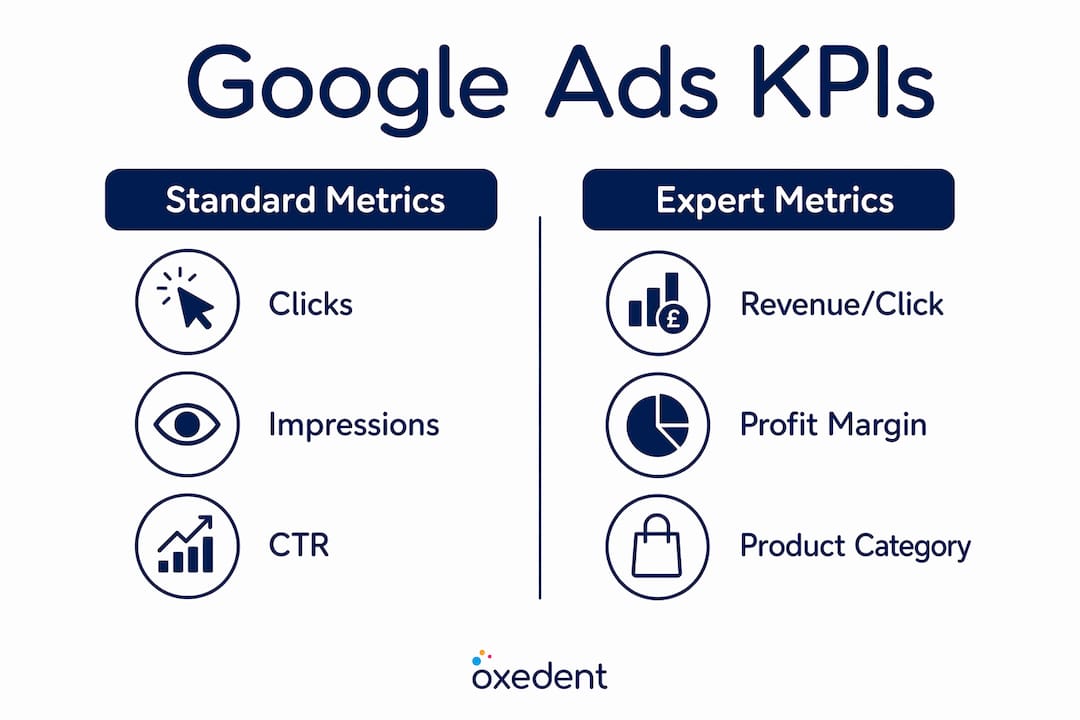

| Standard platform metric | Expert optimisation metric |
|---|---|
| Clicks | Revenue per click by product category |
| Impressions | Impression share lost to budget vs rank |
| Conversion rate | Conversion rate by device and audience segment |
| Cost per conversion | Cost per conversion vs product margin |
| ROAS (blended) | ROAS by campaign type and product feed segment |
This level of analysis requires both platform fluency and business context. An expert at Oxedent, for example, combines Performance Max campaign management with product feed optimisation and margin-aware bidding to ensure spend goes where it generates the most profitable return, not just the most volume.
The long-term benefit is compounding. Clean data improves algorithm performance over time. Better algorithm performance reduces wasted spend. Lower wasted spend frees budget for scaling what works. This cycle does not happen by accident. It requires consistent expert oversight to maintain.
Key takeaways
Expert Google Ads management is the difference between automation that scales profit and automation that scales waste, because the platform’s AI performs only as well as the data and strategy it receives.
| Point | Details |
|---|---|
| Automation needs expert input | Google’s AI amplifies the signal it receives; experts ensure that signal points toward profitable outcomes. |
| Conversion tracking is non-negotiable | Without accurate tracking, the algorithm optimises for clicks rather than revenue, wasting every pound spent. |
| DIY management carries hidden costs | Budget waste, extended learning phases, and lost founder time combine to make self-management expensive. |
| Expert workflow covers six stages | From tracking setup to performance interpretation, each stage requires a distinct skill set no single tool replaces. |
| Integration drives long-term growth | Connecting Google Ads to CRM and margin data enables optimisation for lifetime value, not just conversion volume. |
Why I believe every eCommerce brand needs a proper Google Ads operator
I have watched Google Ads evolve from a platform where manual bid adjustments made a measurable difference to one where the algorithm does the tactical work but demands expert configuration to function properly. The shift has not made management easier. It has made it more consequential.
The accounts I see most often that are wasting budget share one trait: the person managing them is reacting to what the platform shows rather than questioning what the platform is not showing. Performance Max is the clearest example. It reports confidently on metrics that do not tell you where your money actually went.
My honest advice is this: if your monthly ad spend is meaningful to your business, the cost of getting it wrong exceeds the cost of expert help by a wide margin. The question is not whether you can afford a specialist. It is whether you can afford to keep running without one.
The brands that scale consistently are not the ones with the biggest budgets. They are the ones whose campaigns are built on clean data, clear strategy, and someone who reads the results critically every week.
— Biplab
How Oxedent manages Google Ads for eCommerce brands that want to scale
Oxedent specialises exclusively in eCommerce PPC management. Every campaign the team manages is built around profitability, not vanity metrics like clicks or impressions.

The approach starts with conversion tracking, moves through campaign architecture, and continues with ongoing signal engineering and feed optimisation. There are no long-term contracts and no generalist account managers. If you are running Google Ads and not seeing returns that reflect your spend, an eCommerce PPC audit with Oxedent is the clearest next step. The team works with established eCommerce businesses that are ready to treat paid media as a growth channel, not a cost centre.
FAQ
What is expert Google Ads management?
Expert Google Ads management is the practice of configuring data signals, campaign architecture, and creative assets to direct Google’s automation toward profitable outcomes. It goes well beyond logging in and adjusting bids.
Why does Google Ads automation still need human oversight?
Automated bidding strategies like Target ROAS depend on clean, high-volume conversion data. Corrupted or incomplete signals cause the AI to optimise for wasteful outcomes at scale, which only a human expert can detect and correct.
How much budget can negative keywords save?
Negative keyword management can save 20–40% of Google Ads spend by preventing budget from being consumed by irrelevant searches. Regular reviews are among the highest-return optimisation tasks available.
When should an eCommerce business hire a PPC specialist?
The right time to hire a PPC specialist is before significant budget is committed, not after it has been wasted. If your monthly spend is meaningful to your business and you lack daily platform fluency, specialist management pays for itself quickly.
What makes Performance Max campaigns difficult to manage without expertise?
Performance Max does not provide a full budget breakdown by channel or placement. Without expert interpretation, businesses risk scaling poor-performing traits invisibly, spending more on placements that generate volume but not profit.