


If you are running paid search campaigns for a UK eCommerce brand, you have almost certainly felt it. Your budgets are stretching further for fewer clicks, your cost per click keeps creeping upward, and the returns you were used to feel harder to replicate. Understanding why PPC costs are rising in the UK is not just useful background knowledge. It is the foundation for making smarter decisions about where your ad spend goes, how your campaigns are structured, and whether your current approach is actually built for the market you are operating in today.
Table of Contents
- Key takeaways
- Why PPC costs are rising in the UK
- The AI tax: how Google AI Overviews inflate CPCs
- Smart bidding, privacy changes, and Quality Score
- Practical steps to manage rising PPC costs
- My perspective on the AI tax and what it really signals
- How Oxedent helps you control PPC costs
- FAQ
Key takeaways
| Point | Details |
|---|---|
| UK ad spend is at record levels | UK advertising hit £46.7bn in 2025, intensifying competition for every available ad slot. |
| Google AI Overviews are a new cost driver | AI Overviews now appear in over 17% of searches and can cause CPC spikes of up to 97% on exact-match keywords. |
| Smart bidding raises costs without good data | Privacy restrictions leave smart bidding algorithms underfed, causing them to misallocate bids and push CPCs higher unnecessarily. |
| Quality Score is your most accessible lever | Lifting Quality Score from 5 to 8 can reduce CPC by 15 to 25% without increasing your budget. |
| Rising costs do not have to mean falling ROI | Conversion rates reached 8.18% in 2025, showing that well-managed campaigns can improve efficiency even as traffic costs climb. |
Why PPC costs are rising in the UK
The UK digital advertising market has grown significantly. UK ad spend reached £46.7bn in 2025, representing a 6.4% year-on-year increase. That headline figure tells only part of the story. Within that growth, social media grew 21%, retail media grew 17.5%, and addressable TV grew 37%. More advertisers are competing across more digital channels, and Google search is still where the majority of high-intent spending lands.
The core economic reason for PPC advertising costs increasing in the UK is straightforward: supply and demand. Google has a fixed amount of ad inventory on any given search results page. As more brands allocate budget to paid search, the auction becomes more competitive and average CPC rises accordingly. Inflation compounds this. Businesses facing higher operating costs need more revenue, which means more aggressive bidding and less willingness to let a competitor take a high-converting keyword unopposed.
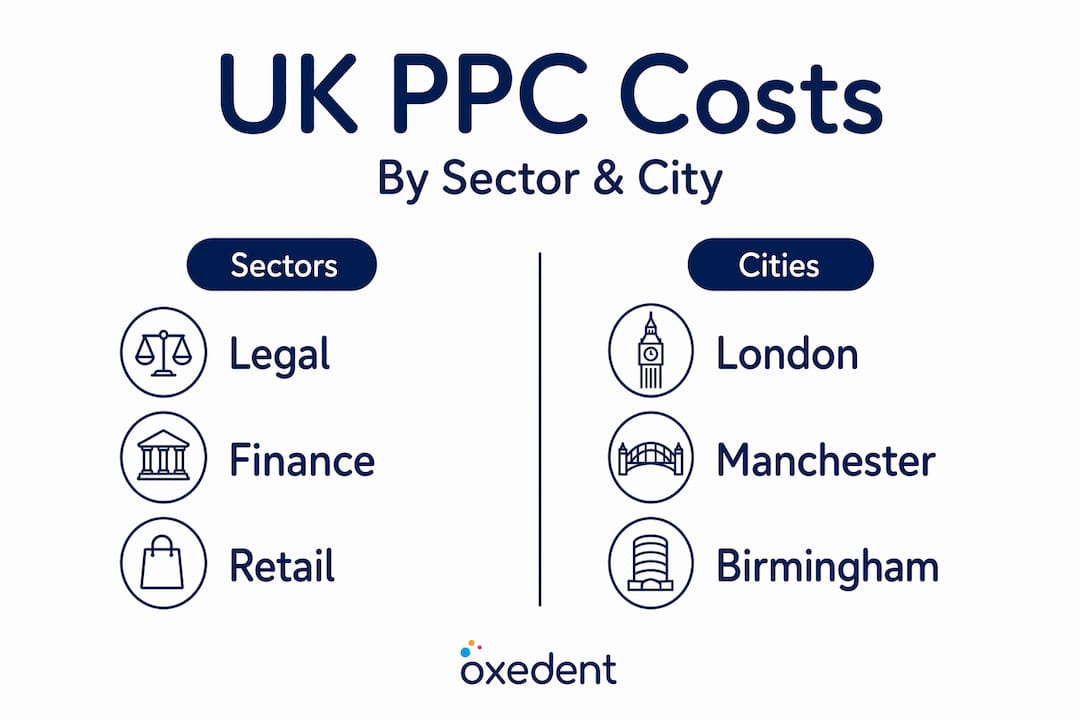
Here is how sector and geography shape the picture:
| Sector | Approximate CPC range (UK) |
|---|---|
| Legal services | £5.00 to £9.00+ |
| Finance and insurance | £3.50 to £7.00 |
| eCommerce and retail | £0.50 to £2.50 |
| Travel and hospitality | £1.00 to £3.50 |
| Healthcare | £2.00 to £5.00 |
Average UK CPCs range from £0.50 to over £9.00 depending on your sector, and location matters too. London CPCs run 15 to 30% higher than equivalent searches in northern England. If your campaigns are not segmented by location, you are likely overpaying in cities where competition is densest.

The average cost per lead in the UK reached £70.11 in 2025, up from £66.69 in 2024. That roughly 5% increase follows a sharper rise the year before. The costs are not spiralling uncontrollably, but they are moving steadily upward, and there is no structural reason to expect that to reverse.


The AI tax: how Google AI Overviews inflate CPCs
This is the factor most UK advertisers are not yet accounting for properly. Google AI Overviews (AIOs) are the AI-generated answer boxes that now appear at the top of search results for a wide range of queries. They are designed to give users an immediate answer without clicking through to a website. That creates a specific and measurable problem for paid search.
AI Overviews appear in over 17% of searches, and when they do, they push paid ads lower down the page. Fewer visible ad positions compete for the same pool of users, and the users who are still clicking are now higher-intent. The auction adjusts accordingly. Advertisers end up paying more per click because the remaining clicks carry more perceived value.
The data makes this concrete. On exact-match keywords where AI Overviews appear regularly, CPC spikes of up to 97% have been recorded. One healthcare advertiser saw their cost per inquiry rise from $102 to $140 in a short period. That is a 38% increase tied directly to AIO presence, not to any change in their own campaign structure or bidding behaviour.
The mitigation steps are worth knowing:
- Identify which keywords in your account have heavy AIO presence by monitoring impression share and CPC trends at keyword level.
- Segment those keywords into separate campaigns so you can control bids independently.
- Apply portfolio bid caps to limit how far Google’s smart bidding will push CPCs on those terms.
- Use the data to decide whether certain AIO-heavy queries are still worth bidding on at all, or whether your budget is better allocated elsewhere.
- Test broader match types on lower-competition variants of the same query, where AIOs appear less frequently.
Pro Tip: Isolate your highest-spend keywords and cross-reference them with a manual check for AI Overview presence on those queries. If they trigger AIOs consistently, add a portfolio-level bid cap immediately. A cap at a sensible CPC ceiling is far less damaging than watching your budget absorbed by inflated auction costs.
The challenge is that measuring AIO impact precisely is not yet straightforward within Google Ads. You are largely working from cost trend signals rather than a clean attribution model. That ambiguity makes it harder to respond, and it is one reason why the AI tax is particularly difficult to manage without close, ongoing campaign oversight.
Smart bidding, privacy changes, and Quality Score
The shift from manual bidding to smart bidding strategies has been broadly positive for conversion volume. Smart bidding increases conversions by 19% on average compared to manual approaches. But there is a cost. Smart bidding bids more aggressively on searches it predicts will convert, which means CPCs on high-intent keywords rise.
The bigger problem is what happens when smart bidding algorithms do not have enough good data to work with. Privacy restrictions cause smart bidding to underperform, because the algorithms are working with incomplete conversion signals. Users blocking cookies, iOS privacy updates, and consent management platforms all reduce the data flowing into Google’s models. The result is that the algorithm misallocates bids. It either overpays for signals it cannot properly evaluate, or it ignores genuinely high-value traffic because it lacks the context to recognise it.
Recovering that lost signal matters. The practical steps include:
- Setting up enhanced conversions, which use hashed first-party data to close some of the privacy-driven gaps in tracking.
- Implementing server-side tagging to capture conversion events that browser-based tracking misses.
- Auditing your conversion actions regularly to confirm you are passing accurate, deduplicated data to Google.
- Aligning your target ROAS or target CPA goals with realistic benchmarks, not aspirational ones that cause the algorithm to under-invest.
Quality Score is the other lever that directly affects why PPC is expensive in the UK for many eCommerce brands. A poor Quality Score signals to Google that your ad and landing page are not relevant to the search, and Google charges you more as a result. Improving Quality Score from 5 to 8 can reduce CPC by 15 to 25% while simultaneously improving your ad position. That is not a marginal gain. That is potentially hundreds of pounds per month recovered without touching your budget.
Pro Tip: Do not chase Quality Score by rewriting ads endlessly. The fastest gains usually come from improving landing page relevance. Match the page headline and content tightly to the keyword and ad copy. Google’s Quality Score is partly based on expected landing page experience, and a high-converting page that speaks directly to the search query outperforms a generic homepage almost every time.
Practical steps to manage rising PPC costs
Accepting that costs are higher is not the same as accepting poor returns. Conversion rates hit 8.18% in 2025, up on prior years, which shows that advertisers embracing smarter automation and intent-driven targeting can still improve efficiency even as traffic becomes more expensive. The goal is to protect margin while scaling what is working.
Here is how to approach that across your key levers:
| Area | What underperformance looks like | What to do instead |
|---|---|---|
| Campaign structure | Broad keyword groups obscuring high-cost terms | Isolate expensive keywords; segment by intent |
| Geographic targeting | Flat national bids regardless of CPC variation | Apply location bid adjustments; reduce bids in high-cost, low-conversion areas |
| Creative and landing pages | Generic ad copy with low expected CTR | Write ads tightly matched to search query; build dedicated landing pages per keyword theme |
| Conversion tracking | Relying on Google tag alone post-privacy changes | Implement enhanced conversions and server-side tagging |
| Budget allocation | Splitting spend evenly across campaigns | Weight budget toward highest-ROAS campaigns and cut waste from low-intent terms |
Beyond the table, a few points deserve more depth. Geographic segmentation is one of the most underused tactics for managing UK PPC pricing trends. Running a single national campaign means London’s elevated CPCs drag up your average cost while delivering returns no better than the same traffic in Manchester or Leeds at half the price. Split your campaigns by region and you can see this clearly within weeks.
Your eCommerce CPA benchmarks should inform your bidding targets. If you do not know what an acceptable cost per acquisition looks like for your product category, you cannot set smart bidding targets with any accuracy. Grounding your targets in sector-specific data is the difference between a bidding strategy that scales and one that drifts.
Brand campaigns remain one of the most efficient ways to protect budget. Your competitors are bidding on your brand terms. If you are not, you are handing them cheap conversions at your expense. Brand campaigns typically carry Quality Scores of 9 or 10, which means low CPCs and dominant ad positions. Investing in PPC for eCommerce growth means treating brand and non-brand spend as distinct problems with different goals.
My perspective on the AI tax and what it really signals
I have been watching UK PPC costs for a long time, and the AI Overviews situation is genuinely different from previous cost pressures. It is not just inflation, and it is not just more advertisers entering the auction. It is a structural change in how Google’s search results page is laid out. The ad space is literally shrinking, and the platform is being redesigned around an AI experience that is not primarily built for advertisers.
What I find concerning is how many eCommerce brands are treating this as a short-term bidding problem when it is actually a longer-term question about channel dependency. If Google continues expanding AI Overviews, the dynamics that are driving today’s cost spikes will become the permanent baseline. Brands that wait for costs to normalise are likely waiting for something that is not coming.
What I have seen work is a combination of tighter campaign architecture and genuine investment in Quality Score improvement. Not as a one-time project but as an ongoing discipline. Brands that treat their ad account like a living system, one that needs regular refinement rather than occasional attention, consistently outperform those that set campaigns and let automation run unchecked.
The other thing I would push back on is the idea that rising costs mean PPC is losing its value. Conversion rates improved in 2025 precisely because advertisers who adapted their structures and tracking got better signal to their bidding algorithms. The opportunity is still there. It just requires more rigour than it did three years ago.
— Biplab
How Oxedent helps you control PPC costs
Rising PPC costs do not have to mean falling margins. What they do mean is that the margin for error in campaign management has narrowed significantly. Generic account structures, poor Quality Scores, and unmonitored smart bidding strategies cost eCommerce brands money every single day.

Oxedent works exclusively with eCommerce brands on paid media. That means every decision made in your account is grounded in retail performance data, not a generalised agency playbook. From feed optimisation and campaign segmentation to eCommerce PPC management that targets real ROAS improvement, the focus is always on profitability rather than activity metrics. If your current account is absorbing more budget than it should be returning, it is worth finding out exactly where the waste is. Oxedent offers audits and consultation with no long-term contract required.
FAQ
Why are UK PPC costs rising so fast right now?
A combination of factors is responsible: record UK ad spend creating a more competitive auction, Google AI Overviews reducing available ad positions, and smart bidding algorithms operating with less data due to privacy changes. All three push CPCs higher.
What is the AI tax in Google Ads?
The AI tax refers to the CPC inflation caused by Google AI Overviews pushing ads lower on the page. With fewer visible ad slots per search, the remaining clicks become more expensive, with CPC increases of up to 97% recorded on exact-match keywords.
How can I lower my PPC costs in the UK?
Improve your Quality Score, apply geographic bid adjustments, isolate high-cost keywords into separate campaigns, and implement enhanced conversions to give smart bidding accurate data. Lifting Quality Score from 5 to 8 alone can cut CPC by 15 to 25%.
Does smart bidding always increase costs?
Not inherently. Smart bidding increases conversion volume on average, but without complete conversion data it misfires and overspends. The fix is better tracking through enhanced conversions and server-side tagging, not abandoning smart bidding altogether.
Are rising PPC costs making Google Ads less viable for eCommerce?
No. Conversion rates reached 8.18% in 2025 despite higher CPCs, demonstrating that well-structured campaigns still deliver strong returns. Rising costs reward better account management rather than signalling a decline in channel viability.