


Ongoing PPC optimisation is the continuous process of refining paid campaigns to match real-time market conditions, audience behaviour, and business goals. Without it, even well-built campaigns lose ground fast. For ecommerce marketers, why PPC needs ongoing optimisation comes down to one hard truth: the auction environment changes daily, and static campaigns bleed budget. Return on ad spend (ROAS) and conversion rate are the metrics that matter most, and both deteriorate without regular attention. The good news is that consistent management, not just a strong launch, is what separates profitable campaigns from expensive ones.
Why PPC needs ongoing optimisation: the core case
PPC campaign optimisation is not a one-time event. It is an active discipline, closer to managing a live trading position than setting up a piece of software. Campaigns without regular refinement experience rapid performance decay because competitor bids shift, search trends evolve, and audiences change their behaviour.
The financial stakes are real. Small improvements of 6% in conversion rate and click-through rate compound into meaningful ROI gains over time. That compounding effect only works if you are making those incremental improvements consistently, not once a quarter.


Ecommerce brands face a particularly volatile environment. Seasonal demand spikes, new product launches, and competitor promotions all alter the auction in ways that a static campaign cannot adapt to. Ongoing PPC management is the mechanism that keeps your spend aligned with actual opportunity.
Pro Tip: Track ROAS and conversion rate week over week, not just month over month. Short-term dips often signal a specific problem, such as a competitor price cut or a broken landing page, that monthly reporting would miss entirely.
How frequent adjustments improve campaign performance
The frequency of your optimisation directly affects your results. Campaigns reviewed weekly significantly outperform those checked monthly because the inputs that drive auction performance, including search demand, competitor bids, and audience intent, shift continuously.
Regular PPC campaign adjustments deliver measurable gains across several dimensions:
- Conversion rate improvement: Weekly bid and keyword reviews catch underperforming ad groups before they drain budget.
- Click-through rate gains: Refreshing ad copy in response to seasonal language or competitor messaging keeps your ads relevant.
- Negative keyword management: Blocking irrelevant search terms weekly prevents budget waste from accumulating into a monthly problem.
- Audience signal refinement: Adjusting audience bids based on recent purchase data keeps your targeting sharp as customer behaviour shifts.
- Budget reallocation: Moving spend toward high-performing campaigns in real time captures demand that a monthly review would miss.
The importance of PPC optimisation also extends to attribution. Ecommerce brands running multiple channels need to validate which campaigns are genuinely driving revenue, not just clicks. Weekly reviews surface attribution anomalies before they distort your bidding strategy.
Pro Tip: Match your optimisation cadence to your campaign scale. A campaign spending £500 per month needs weekly checks. A campaign spending £50,000 per month may need daily monitoring of budget pacing and bid performance.

Does automation remove the need for ongoing management?
Automation is powerful, but it is not a substitute for expertise. This is one of the most persistent myths about PPC optimisation, and it costs ecommerce businesses real money.
Google’s Smart Bidding and Performance Max campaigns use machine learning to adjust bids in real time. Advertisers using Smart Bidding Exploration see an 18% increase in unique converting search queries and 19% overall conversions when actively managing ROAS tolerance. The keyword phrase there is “actively managing.” The gains come from human oversight guiding the automation, not from leaving it alone.
The critical limitation of automation is data dependency. AI-powered campaigns depend entirely on the quality and alignment of the conversion signals they receive. Feed the algorithm flawed data and it optimises precisely toward the wrong outcome.
Automation reacts to the signals it receives. If your conversion tracking fires on a thank-you page that also loads for failed orders, your Smart Bidding algorithm will happily spend more budget chasing those “conversions.” The system is not broken. It is doing exactly what you told it to do. Human oversight is what catches the mistake before it compounds.
Common automation risks that require active human management include:
- Misaligned conversion tracking: Misaligned conversion tracking causes algorithms to optimise for low-quality leads, amplifying inefficiency rather than correcting it.
- Performance Max budget allocation: Without monitoring, Performance Max can funnel spend toward brand search terms rather than new customer acquisition.
- ROAS target drift: Automated targets set months ago may no longer reflect your current margin structure or seasonal goals.
- Learning phase disruption: Frequent large changes reset learning phases, but so does ignoring campaigns until a crisis forces a major intervention.
Automation needs strategic human input to steer optimisation systems. It is a tool, not a manager.
Practical routines for effective ongoing PPC management
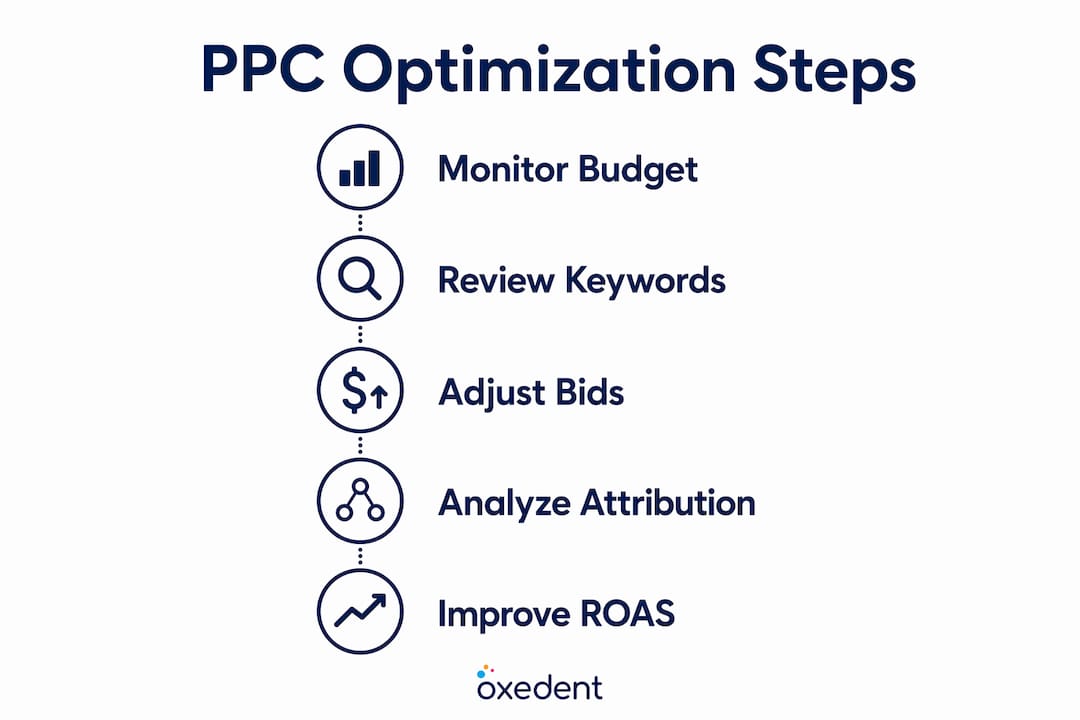
Effective ongoing PPC management runs on a structured cadence. Without a clear routine, optimisation becomes reactive rather than proactive, and reactive management always costs more.
-
Daily: Budget pacing and anomaly detection. Check that daily spend is tracking correctly. Daily budgets should be calculated by dividing monthly spend by 30.4, not by simple daily scaling. Flag any campaign that has spent its daily budget before midday or has underspent by more than 20%.
-
Weekly: Keyword and search term review. Pull your search terms report and add negative keywords for irrelevant queries. Review keyword-level conversion rates and pause terms that have spent more than two times your target cost per acquisition without converting.
-
Weekly: Bid and audience adjustments. Review device, location, and audience segment performance. Adjust bids where data shows a clear pattern. Do not adjust bids on fewer than 30 clicks per segment, as the data is not yet statistically meaningful.
-
Weekly: Ad creative performance. Check which ad variations are winning impressions and conversions. Rotate in new copy for ad groups where the leading variant has been dominant for more than four weeks, as creative fatigue sets in quickly in competitive ecommerce categories.
-
Monthly: Attribution and ROAS review. Validate your conversion tracking setup. Confirm that the revenue values being reported match your actual order values. Review ROAS for ecommerce brands at the campaign and ad group level, and reallocate budget from low-ROAS campaigns to high-ROAS ones.
-
Monthly: Strategic bidding and target review. Reassess your ROAS and CPA targets against current margin data. For B2B-adjacent ecommerce, evaluation windows of 60–90 days are more reliable than 30-day cycles for making scaling decisions.
Pro Tip: Avoid making multiple major changes simultaneously. Changing your bid strategy, restructuring ad groups, and updating your conversion tracking in the same week makes it impossible to isolate what caused any subsequent performance shift. Change one variable at a time.
What happens when you neglect PPC campaign adjustments?
Neglecting ongoing PPC management does not result in campaigns staying flat. It results in active deterioration. PPC campaigns are fragile living systems, and without continuous attention, performance degrades within days due to competitor actions and ad fatigue.
The specific risks of infrequent optimisation include:
- Creative fatigue: Ads shown repeatedly to the same audience generate declining click-through rates, which raises your cost per click over time.
- Competitor bid escalation: A competitor increasing bids on your core keywords pushes your average position down and your cost per click up. Without weekly monitoring, you may not notice for weeks.
- Budget misallocation: Spend drifts toward campaigns with the most historical data rather than the most current opportunity. Continuous manual monitoring is required to detect and correct automation misallocation of budget before it becomes a silent efficiency loss.
- Conversion tracking decay: Tracking pixels break during website updates. Without weekly validation, you may be bidding blind for weeks.
Optimisation focused on ROAS rather than mere conversion volume prevents the common trap of chasing low-value leads while high-value audiences go under-bid. Brands that ignore this distinction often see conversion volume hold steady while actual revenue from paid search quietly falls. Understanding paid advertising for ecommerce means recognising that volume metrics can mask revenue problems for months.
Key takeaways
Ongoing PPC optimisation is the single most important factor in sustaining profitable campaign performance, because markets, competitors, and audiences change faster than any static setup can accommodate.
| Point | Details |
|---|---|
| Weekly beats monthly | Campaigns reviewed weekly outperform monthly-reviewed ones by compounding small conversion rate and CTR gains. |
| Automation needs oversight | Smart Bidding and Performance Max amplify data quality, so flawed tracking leads directly to wasted spend. |
| Structured cadence matters | Daily, weekly, and monthly routines each serve a distinct purpose and cannot substitute for one another. |
| Neglect causes active decline | Creative fatigue, competitor bid shifts, and tracking decay degrade performance within days, not months. |
| ROAS over volume | Optimising for return on ad spend rather than conversion count protects revenue from low-value traffic. |
PPC in 2026: why I think most brands underestimate the work involved
I have managed ecommerce PPC accounts across a wide range of budgets, and the pattern I see most consistently is this: brands invest heavily in campaign setup and then dramatically underestimate what it takes to sustain performance.
The 2026 paid search environment is more automated than ever, which paradoxically makes human oversight more important, not less. Automation moves fast. When it moves in the wrong direction, it does so at scale and at speed. I have seen Performance Max campaigns burn through a week’s budget in two days because a feed issue caused the algorithm to target entirely the wrong product category. No alert caught it. A weekly check would have.
The brands I see scaling profitably are not the ones with the cleverest campaign structures. They are the ones with the most disciplined optimisation routines. They check their numbers, they act on what they find, and they do it every single week without exception. That consistency is what compounds into a genuine competitive advantage over 12 months.
My honest advice: treat your PPC account like a member of staff, not a piece of infrastructure. It needs regular attention, clear direction, and someone accountable for its performance. If that accountability is missing, the account will drift, and drifting accounts lose money quietly until the loss becomes impossible to ignore.
— Biplab
How Oxedent keeps your PPC campaigns performing week after week
Running a profitable ecommerce PPC account in 2026 requires more than a strong launch. It requires consistent, expert management that adapts to market changes before they cost you revenue.

Oxedent specialises exclusively in ecommerce PPC management, with a weekly optimisation cadence built into every client account. The team combines data-led bid management, feed optimisation, and conversion tracking validation with active human oversight of automated campaigns including Performance Max and Google Shopping. Every account benefits from the kind of proactive attention that prevents the silent budget waste most brands only discover in their monthly reports. If your campaigns need a specialist who treats ongoing optimisation as the core of the job, not an afterthought, Oxedent is built for exactly that.
FAQ
Why do PPC campaigns need ongoing optimisation?
PPC campaigns operate in a live auction environment where competitor bids, search demand, and audience behaviour change daily. Without regular adjustments, performance degrades through creative fatigue, budget misallocation, and tracking errors.
How often should I optimise my PPC campaigns?
Effective PPC health requires daily budget monitoring, weekly keyword and bid reviews, and monthly attribution and ROAS assessments. The right frequency scales with your budget size.
Can automation replace manual PPC optimisation?
Automation enhances performance but cannot replace human oversight. Automation alone cannot replace strategic decisions, and flawed conversion data causes automated systems to optimise toward the wrong outcomes.
What is the biggest risk of neglecting PPC management?
Budget misallocation is the most costly risk. Automated systems continue spending based on historical signals even when those signals no longer reflect current market conditions or accurate conversion data.
How does ongoing optimisation improve ROAS?
Regular optimisation reallocates budget from low-performing campaigns to high-value audiences and products. Focusing optimisation on conversion value rather than volume directly improves return on ad spend over time.