


A well-run PPC agency onboarding process is the difference between campaigns that hit the ground running and ones that spend the first three months firefighting broken tracking and misaligned expectations. The onboarding process is the structured sequence of steps an agency follows to integrate a new client, verify the technical foundations, align on goals, and launch campaigns with confidence. Done properly, it spans 2 to 4 weeks, with the first 30 days carrying the most weight for tracking setup, audits, and strategic alignment.
Here is what a thorough PPC client onboarding process covers:
- Kickoff meeting and team introductions
- Access and credentials gathering across all platforms
- Full audit of existing accounts and baseline tracking verification
- Strategic goal alignment and KPI definition
- Campaign structure build and reporting setup
- Communication protocols, launch, and ongoing review
Every step builds on the previous one. Skip the audit and you risk optimising on broken data. Skip the KPI conversation and you create the conditions for a dispute three months later. This guide walks you through each stage in the order it should happen.
1. What does the PPC agency onboarding process actually involve?
The PPC agency onboarding process is the formal handover period between signing a contract and running live, optimised campaigns. It is not simply “getting access to the account.” A structured 2 to 4 week framework covers access and discovery initially, tracking verification in week two, then strategy and reporting setup in week three, followed by launch with an initial review in week four.
The process matters because it prevents the most common failure modes: campaigns launched before tracking is verified, goals that were never written down, and communication that drifts because no one agreed on a cadence. Getting this right at the start protects your budget and your relationship with the agency from day one.
2. Kickoff meeting and team introductions
The kickoff meeting sets the tone for everything that follows. You should meet your dedicated account manager, any platform specialists assigned to your account, and whoever handles reporting. Knowing who to contact for what removes friction from every subsequent conversation.
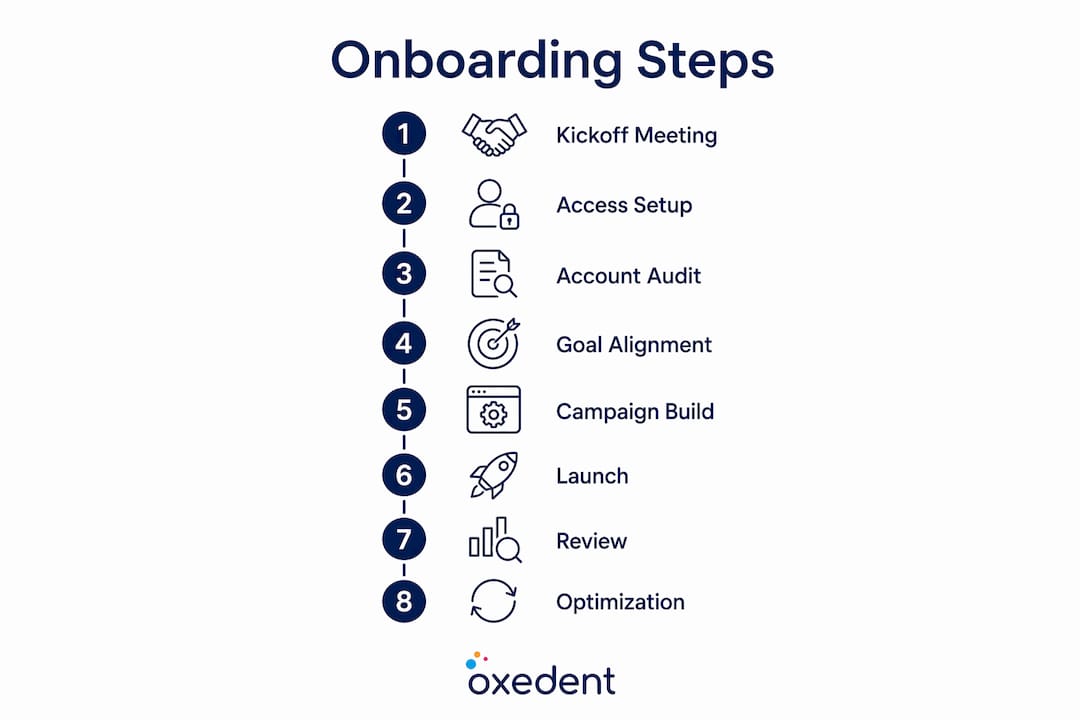

During this session, the agency walks you through the onboarding timeline and its phases, confirms the weekly communication cadence, and identifies the decision-makers on your side for each workstream, as detailed in MVP Design Onboarding – Dropship XL. Clearly defined roles and approval processes prevent timeline drift and delayed campaign launches, which is one of the most common reasons onboardings run over schedule.
Key items to cover in the kickoff:
- Introductions to account manager and supporting specialists
- Overview of the 30-day onboarding timeline and milestones
- Communication cadence: weekly check-ins, async updates, and escalation routes
- Preliminary information about your business, goals, and prior PPC experience
- Signed statement of work or scope document if not already in place
Pro Tip: Send a short intake questionnaire before the kickoff call. Clients who articulate their goals in writing before the meeting arrive with sharper thinking, and the agency surfaces unit economics that determine whether the target metric is even achievable.
3. Access and credentials gathering for all platforms
Access provisioning is the single biggest bottleneck in week one. Request everything on day one, not day five. Most clients take several days to grant full access, so any delay in asking pushes the entire timeline back.


The agency should always request manager-level access rather than account ownership. For Google Ads, this means linking through a Manager account (MCC) using your ten-digit Customer ID. Transparent access via MCC protects your ownership and makes offboarding clean: the agency unlinks, and you keep everything. Never transfer account ownership to an agency’s MCC.
Standard access checklist for PPC onboarding:
- Google Ads: Manager-level access via MCC link
- Microsoft Advertising: Manager account access
- Google Analytics 4: Editor access on the property (not Administrator)
- Google Tag Manager: Publish-level access
- Google Merchant Centre: Admin access for ecommerce accounts
- CRM (HubSpot, Salesforce, or equivalent): Limited access to connect ad data with lead or sales outcomes
- Website or CMS: Sufficient access to verify tracking pixels and landing pages
Confirm that GA4 is linked to the Google Ads account and that conversion imports are flowing before moving to the audit phase.
4. Audit of existing PPC accounts and baseline tracking setup
Before changing anything, understand what you are working with. The audit serves three purposes: identifying critical issues that need immediate attention, documenting the baseline for future performance comparison, and uncovering the optimisation opportunities that will shape the 90-day roadmap.
Verifying tracking accuracy before any campaign optimisation is non-negotiable. Rushing past this step means optimising towards incorrect data and burning budget on signals that do not reflect real business outcomes. This is what practitioners call “verification gating”: the agency halts progression until every tracking pixel and conversion event is fully tested and confirmed firing in a debug environment.
Audit checklist:
- Campaign structure, ad group organisation, and keyword coverage
- Bidding strategies and budget allocation across campaigns
- Quality Score distribution and ad strength ratings
- Impression share lost to budget versus rank
- Negative keyword hygiene and search term waste
- Conversion tracking: tag status, counting method, and attribution model
- GA4 event configuration and conversion event alignment
- Conversion data alignment between ad platform and CRM, checked monthly to maintain campaign integrity
- Landing page relevance and technical health
Document every finding ranked by impact and implementation effort. The deliverable is a written audit summary, not a list of changes already made.
5. Strategic goal alignment and KPI definition
The most common source of friction between agencies and clients is misaligned expectations about what success looks like. The fix is straightforward: write it down and get both parties to sign it.
A KPI contract, mutually signed during onboarding, prevents the most common disputes by defining success metrics clearly and formally. It specifies the target metric (ROAS, CPA, or qualified leads), the baseline it is measured against, the timeframe to reach it, the attribution model used, and which data source governs the numbers. Without this document, the agency reports Google-attributed conversions, you count CRM-closed revenue, and the two figures never reconcile.
Goal alignment should also cover:
- Target audiences: demographics, intent signals, and sales cycle length
- Budget allocation: spend split across campaigns and platforms
- Campaign architecture: keyword themes, ad copy direction, and bidding strategy per campaign
- Reporting cadence: dashboard access, report format, and meeting frequency
- Learning phase expectations: bid strategy changes typically need 2 to 4 weeks to stabilise, so document this upfront to prevent panic during the expected performance dip
For ecommerce brands, this is also the moment to map seasonal patterns, product feed requirements, and any Performance Max or Google Shopping considerations into the campaign structure.
6. Campaign structure build and reporting setup
With goals signed off and tracking verified, the agency builds the campaign architecture. This is production work: campaigns, ad groups, keywords, ad copy, extensions, and bidding strategies are all configured but kept paused until the launch gate in week four.

A well-built PPC campaign structure segments by product line, funnel stage, or geography, with tightly themed ad groups where keywords, copy, and landing pages are all relevant to each other. Sitelinks, callout extensions, and structured snippets are set up at this stage, not retrofitted after launch.
Reporting setup runs in parallel. Build the dashboard before the first report is due, not after. Looker Studio is the standard choice for most clients, pulling from GA4, ad platforms, and Google Search Console into a single view. Define KPIs at three levels: top-of-funnel (impressions, sessions), mid-funnel (engagement, add-to-cart rate), and bottom-funnel (conversions, revenue). More than three KPIs per layer and the dashboard becomes noise rather than signal.
7. Defining billing, invoicing, and contract terms
Billing clarity belongs in the onboarding process, not in a conversation after the first invoice arrives. Confirm the invoicing schedule, payment terms, and what happens to ad spend billing (whether it flows through the agency or directly to the platforms) before any campaigns go live.
Review the contract for notice periods, IP ownership of creative assets, and what access you retain if the relationship ends. A good agency structures access so you own everything: the ad accounts, the tracking setup, the creative, and the historical data. This is not a minor administrative point. Knowing you can leave cleanly, with all your assets intact, is part of what makes the relationship worth committing to.
8. Training and platform walkthroughs for your team
Your internal team should understand what the agency is doing and why. A short walkthrough session covering the reporting dashboard, how to read key metrics, and what the agency monitors day-to-day removes the anxiety that often builds when clients feel out of the loop.
This does not need to be a full training programme. A 30-minute screen-share covering the Looker Studio dashboard, the KPI contract, and the communication channels is usually enough. The goal is to make your team confident consumers of the data, not dependent on the agency to interpret every number. For retail brands new to paid media, Oxedent’s guide on what a PPC agency does for ecommerce is a useful primer to share internally.
9. Communication protocols and contact assignments
Agree on the communication structure in writing during week one. What is daily, what is weekly, and what requires your approval before the agency acts? Clients who define this upfront avoid the two failure modes: agencies that go silent for weeks, and agencies that flood inboxes with updates that require no action.
Regular communication during onboarding, whether weekly meetings or async video updates, builds trust and surfaces business context that intake forms miss. A 15-minute weekly check-in during the first 30 days is the highest-return investment in the relationship an agency can make. After onboarding, the cadence typically scales with spend: monthly reporting calls for smaller accounts, bi-weekly for mid-tier, and weekly for high-spend accounts.
Set up a shared async channel (Slack Connect or a shared email thread) for time-sensitive items between scheduled calls. Document the agreed cadence in the kickoff notes so both parties can refer back to it.
10. Launching the initial campaign
Campaigns go live in week four, after tracking is verified, the audit is complete, the KPI contract is signed, and the campaign structure has passed a click-through QA check. This sequencing is deliberate. Agencies that try to onboard in three days and immediately start optimising churn clients fastest, because they make changes before understanding the account, the business model, or the margin maths behind the target CPA.
On launch day, the agency monitors in real time for the first 24 hours: did spend pace correctly, did conversions fire, did the audience match expectations? Any anomaly gets flagged and addressed within 24 hours. You should receive a launch confirmation update the same day, confirming what went live and what is being watched.
11. First 30-day performance review
The 30-day review is the first formal checkpoint. It covers what launched, what the early data shows, what has been adjusted, and what is planned for month two. This is not a vanity metrics report. It should show baseline performance from before the engagement, changes made during onboarding with early results, and a 60-day roadmap with specific planned actions.
Set expectations correctly: tracking fixes take 1 to 2 weeks to validate, bid strategy changes need 2 to 4 weeks to stabilise, and structural improvements show full impact at 60 to 90 days. The 30-day review is the moment to reset these timelines with real data rather than projections.
12. Ongoing optimisation and feedback loops
After the first 30 days, the relationship shifts from setup to active management. The agency runs a monthly account review as a minimum, checking for tracking breakages, budget pacing, Quality Score changes, and new optimisation opportunities. Build a monthly audit into the workflow; the time it takes to verify the setup is working correctly is far less than the cost of discovering a problem after it has been running for weeks.
Your role in this phase is to keep the agency informed about business changes: new product lines, seasonal promotions, pricing shifts, or changes to your sales process. The agency optimises based on the data it can see. Context it cannot see, like a product going out of stock or a competitor dropping prices, only reaches the account if you share it. A shared Slack channel or brief monthly business update keeps the feedback loop tight.
13. Client documentation and the onboarding sign-off document
Everything from the onboarding process consolidates into one signed document: the audit summary, the KPI contract, the 30-day action plan, the communication cadence, the access log, and the 30-60-90 milestone frame. This document is 4 to 8 pages, written in plain language, and explicitly states what success looks like at each milestone. It is your reference point if expectations drift and the foundation for the first quarterly business review.
Client portals that display onboarding status and deliverable checkpoints reduce misunderstandings and give you a single place to track progress across workstreams. Whether the agency uses a formal portal or a shared project management tool, the principle is the same: onboarding status should never be a mystery.
14. Expert insights on PPC onboarding for ecommerce brands
Ecommerce PPC onboarding carries specific challenges that generic agency processes often underestimate. Seasonal demand patterns mean the audit must capture performance across multiple trading periods, not just the last 30 days. Complex conversion tracking, where a purchase might involve add-to-cart events, checkout steps, and dynamic revenue values, requires more rigorous verification gating than a simple lead-gen setup.
Feed quality is another ecommerce-specific factor that surfaces during onboarding. A product feed with missing attributes, incorrect GTINs, or poor titles will undermine Performance Max and Shopping campaigns regardless of how well the account structure is built. The audit phase should include a feed health check alongside the standard account review. For brands scaling into Performance Max, this is particularly important because the algorithm’s performance is directly tied to the quality of the data it receives.
Pro Tip: Run an audit-first 30-day plan and treat the KPI contract as a preventative dispute tool, not a formality. The clearer the definition of success before spend begins, the fewer conversations you will have about whether the agency is delivering.
Oxedent’s approach to ecommerce PPC onboarding is built around this principle. Every engagement starts with a thorough audit, verified tracking, and a signed KPI framework before a single pound of budget is committed to live campaigns. For brands serious about ecommerce PPC management that prioritises return on ad spend over vanity metrics, getting the onboarding process right is where profitable growth begins.
Ready to start your PPC onboarding the right way?

Oxedent works exclusively with ecommerce brands that are ready to scale. If you want a PPC partner who audits before optimising, documents every decision, and measures success by revenue rather than clicks, get in touch with Oxedent to discuss your onboarding.
Key takeaways
A structured PPC agency onboarding process, spanning 2 to 4 weeks, is the foundation that determines whether your campaigns deliver measurable returns or spend months correcting avoidable errors.
| Point | Details |
|---|---|
| Onboarding spans 2 to 4 weeks | The first 2 to 4 weeks cover access, audits, tracking verification, and campaign launch in a fixed sequence. |
| Verification gating protects your budget | Tracking pixels and conversion events must be confirmed firing correctly before any optimisation begins. |
| A signed KPI contract prevents disputes | Documenting the target metric, attribution model, and data source of truth eliminates the most common agency-client conflicts. |
| Access stays with the client | Manager-level MCC access protects your ownership and makes offboarding clean if the relationship ends. |
| Communication cadence should be agreed in writing | Defining what is daily, weekly, and approval-required in week one prevents both silence and inbox overload. |