


Ecommerce ads lose money when brands optimise for reported return on ad spend rather than actual profit. The industry term for the real measure is contribution margin, and most campaigns never track it. Ad budget waste of 35–45% is typical across ecommerce brands, driven by audience overlap, fatigued creatives, and broken conversion tracking. At the same time, Meta CPMs rose 19.2% year-over-year in Q1 2025, compressing margins further. The result is a growing gap between what your dashboard reports and what actually lands in your bank account.
Why ecommerce ads lose money: the margin problem nobody talks about
The most common reason ecommerce ad campaigns fail is a misunderstanding of gross margin. Many Shopify brands carry only a 30–40% gross margin after variable costs, which means a 3x ROAS frequently achieves nothing more than breakeven. That figure surprises most brand owners because the platform dashboard shows green numbers.
Breakeven ROAS typically sits between 2.5x and 3.3x once you account for all variable costs. Those costs include more than product and fulfilment. Shipping, payment processing fees, returns, customer service, and packaging all reduce the margin available to absorb ad spend.
Here is what erodes real profit before you even look at your ad account:
- Shipping costs: Free shipping promotions often cost 5–10% of order value.
- Payment processing: Stripe and similar processors charge around 1.4–2.9% per transaction.
- Returns: Fashion and footwear brands routinely see return rates of 20–30%.
- Operational overhead: Warehousing, packing, and staff costs are rarely factored into ROAS calculations.
Paid media cannot fix poor unit economics. If margins sit below 40–50% after variable costs, scaling ad spend only scales the losses. The platform algorithm has no visibility into your cost structure. It optimises for conversions, not for your profit.
Pro Tip: Before increasing your ad budget, calculate your true breakeven ROAS using contribution margin, not gross revenue. If your breakeven is 3.2x and your campaigns are running at 3.0x, you are losing money regardless of what the dashboard says.


Does inaccurate conversion tracking cause ecommerce ad campaigns to fail?
Yes. Tracking inaccuracy is one of the most destructive and least visible reasons ecommerce advertising budgets produce poor returns. Between 15 and 30% of conversions are either invisible or double-counted across Meta and Google, depending on your setup. That means your reported ROAS is almost certainly inflated.
The root cause is the post-2020 shift in digital privacy. Apple’s App Tracking Transparency framework, browser-level cookie blocking, and iOS updates all reduced the signal available to ad platforms. Platforms responded by modelling conversions rather than measuring them directly. Modelled data fills gaps but introduces noise.
The practical consequences for your campaigns are significant:
- Duplicate attribution: A customer clicks a Meta ad and a Google Shopping ad before purchasing. Both platforms claim the full conversion.
- Inflated ROAS: Your Meta dashboard reports a 4.5x return. Your actual revenue, when reconciled against orders, reflects a 2.8x return.
- Misguided budget allocation: The algorithm shifts spend toward audiences that appear to convert well but are actually benefiting from attribution overlap.
- Invisible conversions: High-value customers who convert via direct visits after seeing an ad are never credited to any campaign.
The fundamental measurement crisis means brands are allocating budgets based on flawed data. The algorithm then doubles down on those flawed signals, compounding the problem over time. You can improve ecommerce conversion tracking by implementing server-side tagging, auditing your pixel events regularly, and reconciling platform-reported revenue against your actual order management system.
Pro Tip: Run a weekly reconciliation between your Shopify or WooCommerce order data and your ad platform revenue figures. A consistent gap of more than 20% signals a tracking problem that needs fixing before you make any budget decisions.

What campaign structure mistakes waste ecommerce ad budgets?
Campaign fragmentation is the structural mistake that quietly drains budget from otherwise sound strategies. Over-segmented campaigns enter a learning-limited status because each ad set receives too few conversions to generate meaningful signal for the algorithm. The result is erratic delivery, inflated cost per acquisition, and budget dilution across too many competing ad sets.
Audience overlap compounds the problem. When multiple ad sets target overlapping segments, your own campaigns bid against each other in the same auction. You pay more for the same impressions and split the data signal that should be feeding one consolidated campaign.
Creative fatigue is the third structural failure. An ad that performed well in its first two weeks will decay. Click-through rates fall, costs rise, and the algorithm deprioritises the creative. Most brands refresh creatives far less frequently than the data demands.
| Issue | Poor structure | Optimised structure |
|---|---|---|
| Campaign count | 12+ campaigns for one product range | 3–4 consolidated campaigns |
| Audience targeting | Narrow, heavily segmented ad sets | Broad targeting with algorithm-led optimisation |
| Creative refresh | Monthly or less | Weekly review, refresh when CTR drops |
| Budget allocation | Spread thinly across many ad sets | Concentrated in top-performing campaigns |
| Learning status | Frequently learning limited | Consistently active learning |
Algorithms perform better with broad targeting and consolidated campaigns because segmenting fragments data and starves machine learning of the signals it needs to find buyers. Consolidation is not laziness. It is the correct structural approach for modern paid media.
Performance Max campaigns introduce a specific risk. Without negative keyword lists or value-based bidding rules, Performance Max frequently cannibalises branded search traffic. You end up paying for clicks from customers who were already going to buy, inflating your reported ROAS while delivering no incremental revenue. You can explore Performance Max for ecommerce to understand how to configure these campaigns correctly.
How do you know when ecommerce ads are genuinely unprofitable?
Identifying real unprofitability requires looking beyond ROAS. The signs ecommerce ads are unprofitable are often hiding in plain sight once you know what to measure.
-
Declining returns despite stable spend. If your cost per acquisition is rising month on month while your budget stays flat, the campaign is losing efficiency. This is a clear signal of creative fatigue, audience saturation, or worsening tracking quality.
-
Conversion rate below 0.5%. Median ecommerce conversion rates range from 1.5% to 3.0%. A rate below 0.5% points to landing page friction, poor product-market fit, or a tracking failure that is suppressing recorded conversions.
-
Payback period exceeding 120 days. Payback periods can extend to 120 days or longer when measured against contribution margin. Scaling spend before recovering acquisition costs creates cash flow pressure that compounds quickly.
-
Platform ROAS and actual revenue diverge. If your ad platform reports £50,000 in attributed revenue but your orders total £32,000, the gap is a tracking problem. Optimising toward the inflated figure accelerates losses.
-
Customer lifetime value is lower than acquisition cost. Auditing customer acquisition cost against customer lifetime value is the single most important check before scaling any paid channel. If you spend £45 to acquire a customer who spends £40 across their lifetime, no amount of campaign optimisation saves the model.
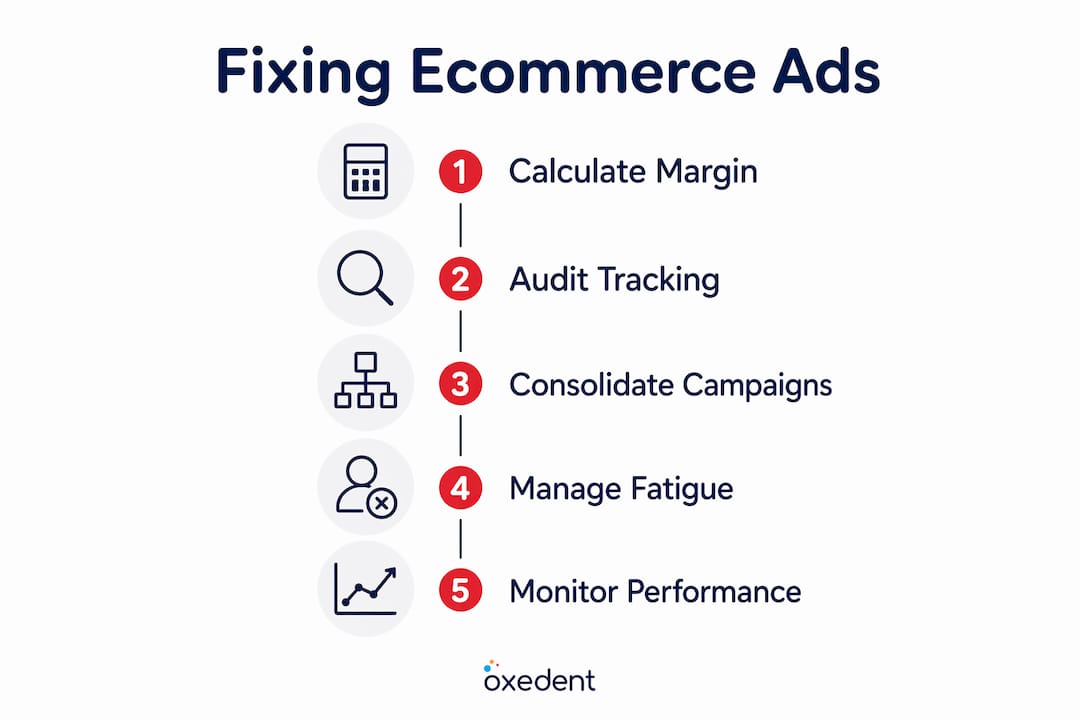
To fix unprofitable campaigns, work in this order. First, confirm your unit economics are sound. Second, audit and repair your conversion tracking. Third, consolidate your campaign structure. Fourth, refresh your creatives based on performance data rather than gut feel. Use the ecommerce ad account audit checklist from Oxedent to work through each layer systematically. You can also read more about why ecommerce ads are not profitable for a deeper breakdown of each failure point.
Key takeaways
Ecommerce ads lose money primarily because brands optimise for platform-reported ROAS rather than contribution margin, while tracking inaccuracies and campaign fragmentation compound the losses.
| Point | Details |
|---|---|
| Margin comes first | A 3x ROAS is often breakeven or a loss once shipping, returns, and fees are factored in. |
| Tracking is unreliable | Between 15 and 30% of conversions are invisible or double-counted, inflating reported returns. |
| Fragmentation wastes budget | Over-segmented campaigns enter learning-limited status and dilute the signal algorithms need. |
| Payback periods matter | Scaling spend before recovering acquisition costs creates cash flow problems within months. |
| Fix fundamentals before scaling | Repair unit economics, tracking, and campaign structure before increasing budget. |
The uncomfortable truth about ecommerce ad profitability
I have reviewed hundreds of ecommerce ad accounts over the years, and the pattern is almost always the same. The brand is not failing because of bad creatives or the wrong bidding strategy. It is failing because nobody has ever sat down and calculated what a profitable customer actually costs to acquire.
The dashboard makes it easy to feel like things are working. Green ROAS numbers, rising attributed revenue, and a busy-looking campaign structure all create the impression of progress. But when you reconcile those figures against actual bank deposits and factor in returns, fees, and fulfilment, the picture changes completely.
What I find most overlooked in 2026 is the interaction between privacy-driven tracking loss and algorithm confidence. Platforms are increasingly modelling conversions they cannot directly observe. That modelled data feeds the bidding algorithm, which then allocates budget based on a partially fictional signal. Brands that do not reconcile platform data against their own order records are, in effect, flying blind.
The fix is not complicated, but it requires discipline. Audit your tracking first. Then calculate your true contribution margin. Then look at your campaign structure. Profitable ecommerce advertising is entirely achievable, but only when the fundamentals are sound before you scale. Throwing budget at a broken foundation does not build anything.
— Biplab
How Oxedent approaches ecommerce ad profitability
Ecommerce brands that work with Oxedent typically arrive with the same problem: their campaigns look profitable on paper but are losing money in practice.

Oxedent specialises exclusively in ecommerce paid media, covering Google Ads, Google Shopping, Facebook Ads, and Performance Max. Every engagement starts with a thorough audit of campaign structure, conversion tracking, and unit economics before any budget decisions are made. The Google Shopping setup guide is a practical starting point if you are building or rebuilding your Shopping campaigns from scratch. For brands running Performance Max, Oxedent’s guidance on feed-only versus full-build configurations helps you choose the right structure for your catalogue and margin profile. If you want a personalised review of your account, Oxedent offers audits without long-term contract commitments.
FAQ
Why do ecommerce ads show profit but lose money?
Platform-reported ROAS excludes variable costs such as shipping, returns, and payment fees. Once those costs are factored in, a reported 3x ROAS often represents breakeven or a loss.
What is a realistic breakeven ROAS for ecommerce?
Breakeven ROAS typically falls between 2.5x and 3.3x for brands with 30–40% gross margins, though the exact figure depends on your full cost structure including fulfilment and returns.
How does poor conversion tracking cause ad losses?
Duplicate attribution and modelled conversions inflate reported ROAS by 15–30%, causing algorithms to allocate budget toward audiences that appear profitable but are not generating real incremental revenue.
What are the signs ecommerce ads are unprofitable?
Rising cost per acquisition, conversion rates below 0.5%, and a growing gap between platform-reported revenue and actual orders are the clearest indicators that campaigns are losing money.
Does campaign structure affect ecommerce ad profitability?
Yes. Over-segmented campaigns enter learning-limited status, dilute budget, and prevent algorithms from gathering enough signal to optimise effectively. Consolidating campaigns into fewer, broader ad sets consistently improves performance.